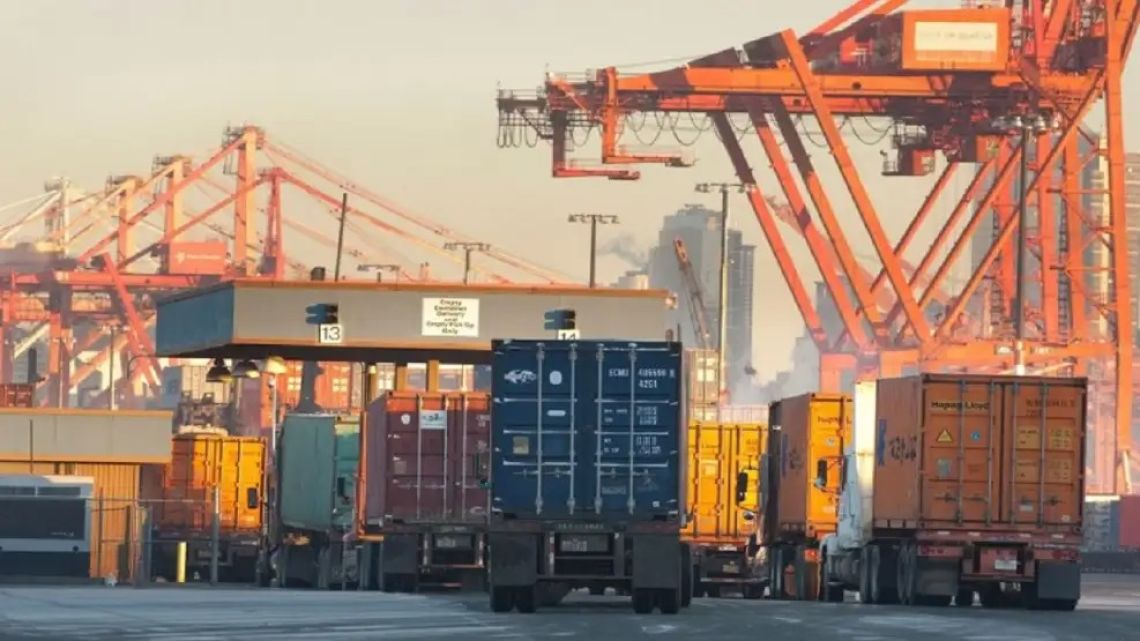
Argentina’s textile sector reels as import surge hits job

Sure, there are companies that are direct shipping small purchases that cost less.
And there are big companies that bring in containers full, and magically pay very little.
Yeah looks like it can be a tool in the year 2026 for to get an idea of the official details importing into Argentina. Just something I found on the web.
It is, as we say in my country, a quilombo. (that means clusterfuck in US slang)
(👏)
 
I have been importing, and occasionally, exporting, small amounts of weird stuff for quite a while, and, no, its not in line with any experiences I have had in other places, particularly in the USA, and sending things to canada or europe.
I used to manufacture a small line of housewares- and sometimes sell things to stores in northern europe or canada.
not like this at all. Usually I filled out the exact form my sewing machine manufacturer filled out, and that was it.

For example, I bought the exact same machine, from the same supplier in India, 3 years ago, to be shipped to the USA.
ZERO customs charges, taxes, tariffs, or delivery surcharges, at my door from New Dehli in one week, prepaid.
Here, 2 to 3 weeks, mostly being processed by DHL and the government, with much added expense and red tape.
The company in Dehli sells them to Africa, or Asia, or Europe, weekly, with no problems.

and I periodically have bought machinery, or oddball supplies, from asia or europe, and, again, most of these fees and complications did not exist. Its true I have had to pay customs brokers for large crated machinery shipped by sea, from europe, but much less, and much quicker and easier, than here, in the USA.


One of the things that makes Argentina unique, and valuable globally, is the incredible number of small manufacturers, most with pretty unusual products and decent quality.
And they are mostly not importing container loads- thats what Aldi or Target or Walmart do, with the subsequent commonality of cheap mass produced consumer goods.
The very thing that makes Argentine production saleable abroad is what is made more difficult by the small scale imports being so expensive.
The government could choose to help local industry, both to produce for domestic consumption, and for export.
Instead it does a very good job of hindering.

I would say you've been fairly lucky then in your experience.

I think I remember buying poker chips 20+ years ago from eBay and getting surprised by the brokerage bill.
I think in Canada the limit at the time was $20.
Similarly, I know someone that tried to buy a CNC table from Alibaba in another country and also had expenses and then I think the additional charges for storing in customs since it wasn't organized well and first time they were ever doing that type of freight.
After Trump removed the de minimis exemption in the US a lot of people got stung with their purchases in the US with the brokerage fees.
This is also now a huge issue for small businesses in Canada. Most products fall under USMCA, before though, due to de minimus exemption, many small businesses sale would fall under the limit so it was easy doing cross border business, after the exemption was pulled, some had to begin the paperwork to get certified as Canadian made product to continue tariff free, others couldn't and it ended their business.

Brokerage fees are charged by the agent, or courier if done by them. They can charge whatever they want.
That doesn't have anything to do with the government.

I have lived in countries with $200 exemption allowance and a very good and functioning freight forwarding system from the USA to the country with local distribution shops throughout the country and it was about $6-10/kg, cleared customs, and was in a local pickup or home delivered for that fee in sometimes 3 days. And if there was a duty to be paid (in excess of $200) then you paid it too without a crazy brokerage fee. The fees are not a government issue, they are due to the couriers and logistic companies.

I just checked shipping estimated

I assumed 24" x 12" x 12" and 10 kg (22lb) and $100 if asked.
Parcel Monkey (quotes from various services ($150 - 1000)
Aerobox $295
Viabox ($225-1000)

For similar but only 1 kg.
Parcel Monkey (quotes from various services ($44 - 140)
Aerobox $90
Viabox ($222-990)

For small packages shipping is still pretty expensive. Amazon might be different if they are handling the shipping and customs clearance portion themselves and then handing off to a local delivery service. I know in other countries they tried to switch from the freight forwarder model to more direct, but I have heard issues with the last leg of delivery (not in Argentina).

I also don't know how all those companies charge for brokerage. On the website it looks like that is included in Viabox fees, but you still pay the tariff on top.
 
I have never heard of ansilta, so I looked it up- technical climbing gear.
I compared the puffy jacket from ansilta, which is $230 at todays rate, with the equivalent Patagonias, in the US- and they range from $249 to $379. I used to live in Ojai, up the road from Patagonias headquarters, and have been buying seconds and sale Patagonia for 35 years, and it is not cheaper than Ansilta. People like Caputo are not buying Patagonia to climb mountains, its a fashion thing. And theres a ton of "fashion" grade puffer jackets on mercado libre for under 100,000 pesos. Some for 50,000 pesos. NO, they arent Patagonia, but they arent $300USD, either.
Lots of reasonably priced argentine clothing is far cheaper than name brand global stuff.
LOL can you see Caputo climbing a mountain??? He is cos-playing his role all day, every day. He makes up sh*t every time he talks.
 
I understand your position. But I think its related to how its done.
One off shipments as an individual will always cost more. Even in the US. Business rates for shipping with FedEx, UPS are different than customer rates, and they also can vary based on quantity.
In terms of brokerage fees, those aren't the duties themselves, and again they can vary.
If you bring in a container, your brokerage fee may still be just a few hundred dollars, even if the bill of loading is a million dollars I believe, and you have 5000 different items inside.
There are other places the freight forwarders that charge a flat fee per kilo and thats inclusive for all. Here I have seen them charge $40-50/kg but to me that is ridiculous. In other countries it was $6-10/kg I think, maybe a bit more now. I really don't understand why it is as high as it is here as cargo shipping isn't that expensive. But again, the way they operate is they will consolidate a bunch of boxes into a single bag for instance, use cargo shipping rates on airlines or with commercial cargo companies, and they streamline the process. This is why many businesses prefer to just deal with importers rather than import themselves.

Your experience is very much in line with many peoples experience elsewhere globally. If you are over the de minimis allowance you can get stung with the brokerage fees and admin costs from the couriers. Similar experiences when people try to buy something for the first time off Ali Baba but they don't have a logistics/freight provider, and it becomes a huge mess, and then you have to pay "rent" for the delays it is held in customs.
LOL de minimis! There is no de minimis in the US anymore!
 
I have been importing, and occasionally, exporting, small amounts of weird stuff for quite a while, and, no, its not in line with any experiences I have had in other places, particularly in the USA, and sending things to canada or europe.
I used to manufacture a small line of housewares- and sometimes sell things to stores in northern europe or canada.
not like this at all. Usually I filled out the exact form my sewing machine manufacturer filled out, and that was it.

For example, I bought the exact same machine, from the same supplier in India, 3 years ago, to be shipped to the USA.
ZERO customs charges, taxes, tariffs, or delivery surcharges, at my door from New Dehli in one week, prepaid.
Here, 2 to 3 weeks, mostly being processed by DHL and the government, with much added expense and red tape.
The company in Dehli sells them to Africa, or Asia, or Europe, weekly, with no problems.

and I periodically have bought machinery, or oddball supplies, from asia or europe, and, again, most of these fees and complications did not exist. Its true I have had to pay customs brokers for large crated machinery shipped by sea, from europe, but much less, and much quicker and easier, than here, in the USA.


One of the things that makes Argentina unique, and valuable globally, is the incredible number of small manufacturers, most with pretty unusual products and decent quality.
And they are mostly not importing container loads- thats what Aldi or Target or Walmart do, with the subsequent commonality of cheap mass produced consumer goods.
The very thing that makes Argentine production saleable abroad is what is made more difficult by the small scale imports being so expensive.
The government could choose to help local industry, both to produce for domestic consumption, and for export.
Instead it does a very good job of hindering.
I want to go on record and say I agree with you 100% re "One of the things that makes Argentina unique, and valuable globally, is the incredible number of small manufacturers, most with pretty unusual products and decent quality.
And they are mostly not importing container loads- thats what Aldi or Target or Walmart do, with the subsequent commonality of cheap mass produced consumer goods.
The very thing that makes Argentine production saleable abroad is what is made more difficult by the small scale imports being so expensive.
The government could choose to help local industry, both to produce for domestic consumption, and for export.
Instead it does a very good job of hindering."

Milei and Co's war against "industria argentina" is so horrible to see. Milei must really worshipThatcher and Reagan (in addition to Adam Smith - who in their right mind would pay homage to Adam Smith at a ceremony at the Centro Cultural Kirchner????????????) bc they too killed their respective national industries.
 
I want to go on record and say I agree with you 100% re "One of the things that makes Argentina unique, and valuable globally, is the incredible number of small manufacturers, most with pretty unusual products and decent quality.
And they are mostly not importing container loads- thats what Aldi or Target or Walmart do, with the subsequent commonality of cheap mass produced consumer goods.
The very thing that makes Argentine production saleable abroad is what is made more difficult by the small scale imports being so expensive.
The government could choose to help local industry, both to produce for domestic consumption, and for export.
Instead it does a very good job of hindering."

Milei and Co's war against "industria argentina" is so horrible to see. Milei must really worshipThatcher and Reagan (in addition to Adam Smith - who in their right mind would pay homage to Adam Smith at a ceremony at the Centro Cultural Kirchner????????????) bc they too killed their respective national industries.


Ries example of importing was an experience he had 3 years ago, which was before Milei's administration. From my experience in industry in Argentina, customs clearing and importing did improve a lot with this administration. You now also have Amazon which handles much of that for you.

I am not really sure what more you want the government to do for import, AND export?

What is the issue with exporting? Produce a Factor E.

It is the courier companies that charge the money for the Brokerage fees, not the government.
My experience is that there are companies in other countries that handle those much cheaper than here. I have provided comparisons for services in Argentina.

If you are a small business, then you are best suited to use the freight forwarding company such as Viabox, consolidate and repackage your packages and they will ship in a single package with everything. That is your best bet probably as a small business. The other that was cheaper from Parcel Monkey I am not sure about how they handle brokerage fees.

Without more details, I am not really sure I understand the problem with the government.

You seem to think everything is a war against Industria Argentina. But where I live people aren't happy with what they charged and the quality received. They go to Chile a few hours drive to go shopping, holidays etc. or I am asked to bring back Jeans or Shoes etc when I travel. I don't think its really a war against Industria Argentina, I think its more realizing that the type of economy in Argentina has changed and that they need to start accepting that. and by changed I mean it is an open economy no longer closed and completely protected which gave businesses monopolies and cartel like pricing power. Can you tell me why Techint wanted allowance for a second bid when their first bid was rejected because it was way overpriced? Why didn't they provide the cheaper price in the first round of bids? Do you not see that they were used to charging a premium in the country (67% more, since the Indian bid was 40% less) ? If they get a chance at a second bid after theirs was rejected and they know the other, then what is the point of the tender process? That example goes to show exactly the issue.
 
You misread me.
My experience importing TO Argentina was december 2025.
And, like many small businesses here, I was importing a particular industrial product, not a pair of generic jeans from Amazon. I was importing this machine directly from the factory in New Dehli.
I know various manufacturers here who have similar issues, such as a factory I visited in La Matanza that bought a textile specific laser for distressgns on a large scale. Not something you get from viabox.
I am talking about industry specific machines, often built to order, some airfreight and some by ship…
 
One has to wonder...if an Argentine buys clothes in China with $100,000 pesos, did money really flow out of the country? Did the china man take a textile worker's money?

The china man sold his clothes to the Argentine but now has a $100,000 pesos to get rid of. What can he do with it? He must buy something in pesos from Argentina to get rid of it. The china man buys soymeal for his cows from an Argentine soy producer. A zero-sum transaction.

Another scenario, the Argentine buys on Shein a shirt for $10. The BCRA sells you $10 for $18,000 pesos using the dolar tarjeta. Did the pesos leave the country? No, dollars did. You sold your pesos to the BCRA for dollars. The pesos stayed within the country. Again, a zero-sum transaction. You then used your dollars and sold them to the Chinaman for clothes. The china man used his dollars to buy US Treasuries. Did the textile worker lose dollars, then? Does an American lose dollars when he buys soymeal from Argentina? Does the textile worker then gain pesos from the soy producer who had to sell the dollars he made from the American to the BCRA for pesos?

Perhaps what matters at the end of the day is trade and whether it's a trade deficit or a trade surplus to really determine who is receiving more and who is receiving less. The sectors will shift depending on the trade.

When I see an article like this:


I begin to wonder which Argentine sector benefited and which sector lost. In a trade surplus, for every textile worker who lost, another worker should be winning more. Who are the Argentine winners in this trade surplus? Where is their story?

Of course, class warfare would have you believe the poor textile worker lost his pesos to the evil Argentine soy magnate. Can the evil Argentine soy magnate produce more soy without hiring more workers, purchasing more seed, fallowing more land, repairing more tractors? Questions abound. How can we manipulate this playing field? Can we cap how much the soy magnate can export? That means less trade surplus. Can we cap how many clothes get imported? That means less trade deficit. A zero-sum game.

How about this, can we stop all imports and only export things? That should produce a huge surplus and nobody loses, right? Except, nobody outside of Argentina now has pesos to spend. Argentina only has dollars from exporters, which must be either spent abroad or sold to the BCRA for pesos. Argentine producers are stuck only selling things to those who have pesos... which is other Argentines. Who is winning now? The evil soy magnate has gained more international market share, but what happened to the textile factory? Has the textile factory gained international market share? Has the tire factory gained international market share? A zero-sum game.

We won't know what the international market will do with their pesos until we give some to them. They will need to spend those pesos in Argentina, and perhaps new Argentine sectors will rise up to sell something to them for those pesos.

The word “Chinaman” is pretty offensive and derogatory, it's the same to call a black person "N" word or a white person "redneck", it doesn't give you any swagger for using a racist word. It's not something you should be using to describe anyone, and if English is your first language, you probably already know that.

If you’re living in Argentina as an expat, I’d assume valuing equality and respect is part of why you chose to be here.
 
The word “Chinaman” is pretty offensive and derogatory, it's the same to call a black person "N" word or a white person "redneck", it doesn't give you any swagger for using a racist word. It's not something you should be using to describe anyone, and if English is your first language, you probably already know that.

If you’re living in Argentina as an expat, I’d assume valuing equality and respect is part of why you chose to be here.

Yes we've seen the Big Lebowski. But @LuckyLuke didn't say "Chinaman", he said "china man", an important distinction.

1774213151777.png
 
Back
Top