Argentines plunge into debt for bills, cars and birthday parties

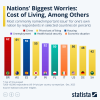
This is a complex topic, and it would repay choosing the terminology carefully. For example, being worried about the cost of living would not seem to translate into being "plunged into debt". In fact, I'd suggest that the countries with the most indebted households (which include the well known banana republics of Switzerland, Australia, and Canada... the last two are dominions, not republics, of course, and according to the Economist only last week, Norway should top the list with an average household debt of 250% of gross income) are singularly unworried.

We might be on to something, if we consider the countries with the highest loan delinquency rates, and here Argentina seems to be a stellar performer, "loan defaults reached 7.8% in October 2025, rising from just over 2% the previous year". There are certainly others: "Cyprus leads in non-performing loans (9.0% of GDP), followed by Croatia (0.8%) and Greece (0.6%)".

But we can say that Argentina is on a spectacular trajectory going entirely the wrong way, with implications the government has even to imagine, let alone figure out and resolve.

[Disclaimer: I used AI to find some of the statistics here, otherwise, it's all me :) ]
 
This is a complex topic, and it would repay choosing the terminology carefully. For example, being worried about the cost of living would not seem to translate into being "plunged into debt". In fact, I'd suggest that the countries with the most indebted households (which include the well known banana republics of Switzerland, Australia, and Canada... the last two are dominions, not republics, of course, and according to the Economist only last week, Norway should top the list with an average household debt of 250% of gross income) are singularly unworried.

We might be on to something, if we consider the countries with the highest loan delinquency rates, and here Argentina seems to be a stellar performer, "loan defaults reached 7.8% in October 2025, rising from just over 2% the previous year". There are certainly others: "Cyprus leads in non-performing loans (9.0% of GDP), followed by Croatia (0.8%) and Greece (0.6%)".

But we can say that Argentina is on a spectacular trajectory going entirely the wrong way, with implications the government has even to imagine, let alone figure out and resolve.

[Disclaimer: I used AI to find some of the statistics here, otherwise, it's all me :) ]

I really don't think the country is on a terrible trajectory.
I think Argentinians think their country is always in a terrible position and are expecting the government to fix it and that should happen quickly. Even though there has been decades of issues to fix and policy errors. I also think there is more to the country than CABA.

Over 10% of Torontonians are dependent on Food banks. it used to be 25-30% of a Canadians salary went to housing costs, now it can be 50-60%. 1 in 5 Canadians report skipping meals to pay bills etc. It is amongst the most indebted countries, unsure how it wasn't included in the first graph. Anyone who is not currently a homeowner is finding it very difficult to enter the market. Due to the cost of living, many are unable to save for the down payment.

Japan is going through a major inflation problem.

To suggest that the rest of the world doesn't live on debt is pretty radical. I think the stat is 50% of Americans don't have $500 for an emergency. They can't protest for fear of losing a job and health insurance. In developing countries they issue 2 debits cards sometimes to a single person account holder. I have been told that the second card gets handed over to the person they get loans from so on pay day they can take the money.

My point, there are issues globally right now. Everywhere has become more expensive, and essentially everywhere salaries are not moving let alone rising as fast as inflation. At least here there is a formal mechanism that many unions etc have that tie wages to CPI and other metrics, albeit with a delay.

Again, the rest of the country doesn't seem to be doing that poorly. In the interior there is a lot of construction and businesses starting. In an election 6 months ago, the government received surprisingly high support suggesting the population supports them and the path. There is more to Argentina than BA.
 
I really don't think the country is on a terrible trajectory.
I think Argentinians think their country is always in a terrible position and are expecting the government to fix it and that should happen quickly. Even though there has been decades of issues to fix and policy errors. I also think there is more to the country than CABA.

Over 10% of Torontonians are dependent on Food banks. it used to be 25-30% of a Canadians salary went to housing costs, now it can be 50-60%. 1 in 5 Canadians report skipping meals to pay bills etc. It is amongst the most indebted countries, unsure how it wasn't included in the first graph. Anyone who is not currently a homeowner is finding it very difficult to enter the market. Due to the cost of living, many are unable to save for the down payment.

Japan is going through a major inflation problem.

To suggest that the rest of the world doesn't live on debt is pretty radical. I think the stat is 50% of Americans don't have $500 for an emergency. They can't protest for fear of losing a job and health insurance. In developing countries they issue 2 debits cards sometimes to a single person account holder. I have been told that the second card gets handed over to the person they get loans from so on pay day they can take the money.

My point, there are issues globally right now. Everywhere has become more expensive, and essentially everywhere salaries are not moving let alone rising as fast as inflation. At least here there is a formal mechanism that many unions etc have that tie wages to CPI and other metrics, albeit with a delay.
If a increase in loan delinquency from 2 to almost 8% in a year isn't "terrible" (your word, not mine), then what do you suggest would be "terrible"? Bear in mind, the data I found is from last October, do you think the loan delinquency rate is better now?

The rest of your statistics are just snapshots, I have no idea about Toronto, Japan is probably happy to have inflation for a change, rather than the persistent deflation is had been dealing with, nobody has suggested that the rest of the world doesn't live on debt, and it's all irrelevant to the point I was making: it's the trend, or the trajectory, that matters.

Put simply, are things getting better, or are they getting worse for normal consumers? The deterioration in loan delinquency suggests strongly that things are getting worse, fast. People who cannot pay off their credit cards, bank loans, mortgages, or whatever, are not doing well. And people with those loans are (or were) probably among the better-off Argentinians.

Again, the rest of the country doesn't seem to be doing that poorly. In the interior there is a lot of construction and businesses starting. In an election 6 months ago, the government received surprisingly high support suggesting the population supports them and the path. There is more to Argentina than BA.

You do go on about this... 35% of Argentinians live in AMBA, 38% in CABA + PBA. There is more to Argentina than BA for sure, nice waterfalls and mountains and so on, but still, this is where things happen. And the "surprisingly high support" the government received after buying the election to the tune of USD 20 billion with the help, and election interference, of the demented orange man has, seemingly, evaporated:

"President Javier Milei’s approval rating fell in March to the lowest level since he took office as corruption allegations ensnared his government, unemployment climbed and Argentines soured on his trade deal with the Donald Trump administration."

(From: https://www.batimes.com.ar/news/arg...ew-low-as-argentinas-unemployment-rises.phtml). "Milei’s approval rating fell to 36.4 percent, a five-point drop from February, while disapproval climbed six percentage points to nearly 62 percent." You surely don't live under a rock? Whatever, please give over with the gaslighting.

 
Last edited:
If a increase in loan delinquency from 2 to almost 8% in a year isn't "terrible" (your word, not mine), then what do you suggest would be "terrible"? Bear in mind, the data I found is from last October, do you think the loan delinquency rate is better now?

The rest of your statistics are just snapshots, I have no idea about Toronto, Japan is probably happy to have inflation for a change, rather than the persistent deflation is had been dealing with, nobody has suggested that the rest of the world doesn't live on debt, and it's all irrelevant to the point I was making: it's the trend, or the trajectory, that matters.

Put simply, are things getting better, or are they getting worse for normal consumers? The deterioration in loan delinquency suggests strongly that things are getting worse, fast. People who cannot pay off their credit cards, bank loans, mortgages, or whatever, are not doing well. And people with those loans are (or were) probably among the better-off Argentinians.


You do go on about this... 35% of Argentinians live in AMBA, 38% in PBA. There is more to Argentina than BA, nice waterfalls and mountains and so on, but still, this is where things happen. And the "surprisingly high support" the government received after buying the election to the tune of USD 20 billion with the help of the demented orange man has, seemingly, evaporated:

"President Javier Milei’s approval rating fell in March to the lowest level since he took office as corruption allegations ensnared his government, unemployment climbed and Argentines soured on his trade deal with the Donald Trump administration."

(From: https://www.batimes.com.ar/news/arg...ew-low-as-argentinas-unemployment-rises.phtml). "Milei’s approval rating fell to 36.4 percent, a five-point drop from February, while disapproval climbed six percentage points to nearly 62 percent." You surely don't live under a rock? Whatever, please give over with the gaslighting.
No the Japanese people do not want inflation. Watch videos about. Japan is cheap to foreigners but to Japanese its expensive now. The inflation is outpacing salaries. It is becoming increasingly difficult for them. Macroeconomics is different than microeconomics. One could say the same for Argentina. There are varying impacts across an economy by industries, hence it will impact different regions differently.

Yes 35% of Argentinians live AMBA, they are also not all doing poorly. It is the same in every city, and every economy.

The credit swap of $20B only about $2.5B was drawn and it was repaid. The other $20B that they wanted private banks to setup a credit facility they only did in the ball park of $5B or so, and that is again a credit facility where the country pays interest and is not guaranteed by the US Government.

The popularity will vary between elections, but people know going into a vote that they need make a choice and they chose to continue on the path.

Mendoza, San Juan, Salta, Catamarca and other provinces with mines and petroleum are doing well. There is lots going on. The agriculture industry is having another good year as I understand it. Meat exports are increasing, and this month is Argentinian meat week in the US to try to further boost demand.

Caputo announced that funding for public works is restarting (Public Works Article). They say this will create 36,000 jobs, but it won't all be in AMBA. How many people are willing to move? I know some people that lived in central Argentina and travelled by flight to south Argentina for work and vice versa on a rotational schedule. I know people that commute 2-4+ hours each way between provinces by car for their rotations.

One of the biggest issues holding back the economy is a good credit market. Borrowing money is expensive here. The government came out just last week I believe with a new program for small business owners to get loans at 23 and 25% (Infobae - Credit Article). People also don't want to deposit money into banks then how do they loan it out? The banks are also asking for changes to the rules about USD funding and loans. But should the government be printing money to increase liquidity? What happens when they do that? Inflation.

Some people are expecting solutions to happen overnight, which just doesn't happen. An economy of 47M has a lot of inertia and doesn't move so quickly. Especially given the history. But what I can see where I am as that there is a lot of activity going on. What I can see from the lower country risk and billions of dollars of loans being issued to Argentinian governments at different levels and businesses is that foreigners believe in what is happening and the path forward and therefore that they will get their money and interest back. The question is, are the people willing to move, or do they expect it to come to them?

Do you also believe the 2-3% inflation rates reported in North America? or is that not real? Everything is increasing around the world, not just Argentina. And it is increasing faster than salaries, everywhere.

In the US and Canada is everyone not living on debt, mortgages for houses, car loans and financing. Why do we think this is unique to Argentina? I understand trying to live and enjoy life, but if one is in very hard situations, then is it fiscally responsible to take out additional debt without secured income for a new car or to throw a party? Individuals are deciding that it is worth, even at the cost of interest. Credit companies will enable it because they make money of loans. Its the nature of their business. It is also required for economic growth. But its still up to individuals do so responsibly.
 
...Everything is increasing around the world, not just Argentina. And it is increasing faster than salaries, everywhere.

This is a question that has been rattling in my brain the past year. I've dabbled in economics for a while, but I honestly struggle to understand how, with what should be regional balance of trade, credit cycles, macro/micro feedback loops, geopolitical factors, etc. that could cause so many countries to experience the same phenomenon of falling purchasing power simultaneously. Some hint at a global recession, however those tend to cause disinflation. Some talk about rampant fiscal deficits coming home to roost. But so many countries together? Why now...has the perception of debt suddenly changed? Have we hit an inflection point on sovereign debt rates that are consuming a greater percentage of GDP? Are demographics finally showing cracks in the fiat growth model? The correlation of these countries may not share a common causation, but it feels like a common phenomenon occurring right now.
 
This is a question that has been rattling in my brain the past year. I've dabbled in economics for a while, but I honestly struggle to understand how, with what should be regional balance of trade, credit cycles, macro/micro feedback loops, geopolitical factors, etc. that could cause so many countries to experience the same phenomenon of falling purchasing power simultaneously. Some hint at a global recession, however those tend to cause disinflation. Some talk about rampant fiscal deficits coming home to roost. But so many countries together? Why now...has the perception of debt suddenly changed? Have we hit an inflection point on sovereign debt rates that are consuming a greater percentage of GDP? Are demographics finally showing cracks in the fiat growth model? The correlation of these countries may not share a common causation, but it feels like a common phenomenon occurring right now.

Based on things I have read and watched this is just my opinion but a lot changed with the pandemic. Almost every country followed the same playbook which was spend big. These were massive deficits that made huge impacts to debt levels. This kicked off inflation. They then had to raise interest rates to try to cool it down. With much larger debt loads and higher interest rates, financing costs increased. To try to offset a slowing economy due to higher rates, governments introduced other programs to try to spur the economy. And then finally, trying to offset the impact of tariffs and prevent recessions governments were once again spending big or reducing taxes. There seems to always be a reason to maintain significant deficit spending. The availability of relatively cheap credit has enabled many people and companies to continue to spend. Additionally, its reported that its a smaller part of the population that is doing much of the spending. GDP gets skewed by certain industries so it means there can become a divergence between wall street and main street, and have similar impact on macroeconomic KPIs vs microeconomic finances.

Demographics becomes a separate issue for countries based on their tax and pension contribution base (workers). This is why many countries had increased immigration. The issue is that although that could have been foreseen, they didn't increase the infrastructure to match and as a result there are inadequate resources (doctors, schools, homes etc) which is also increasing demand and supporting or maintaining increasing prices. This is why there isn't as much as a decrease.
 
Back
Top