Has Argentina Become Worse Or Better for Foreign Retirees recently?

How is that so? It was great because of the prices but now who would want to put up with all this stuff with a humongous price tag! Before you could go to best restaurants at very reasonable prices, great sports activities at very reasonable prices. I’m traumatised with the “no quality for astronomical prices”. Bought a small box of chocolates at a shop on Federico Lacro for $15. Same thing in Lidl in London for $2! I’m Argentinean. My wife born and bred Argie. We live in Europe and none of our friends who are here going to Argentina every year for a month any more. Because it’s crazy expensive.

Like Ries mentioned above, I don't find Argentina more expensive than other places as a whole.
Housing, most foods are equal or cheaper here, and could be significantly cheaper so it depends on your diet, compared to North America.
Housing is much cheaper here I find.
Utilities are cheaper here. Even where variable rate for gas or electricity can be similar, the fixed portion of the bill for sewers, transmission lines, system upgrades, connections, etc is much cheaper here.
Certain things imported will be more expensive. But to be fair, when I look online for some stuff at Amazon and compare to what it would cost here, its actually not that bad. The issue might be the ability to find what you are looking for, but Amazon changed during the pandemic when everyone because almost wholly reliant on it. It is no longer as cheap as it was, and every listing is for the same chinese product just being run by different drop shipping businesses.

I also don't understand how bureaucracy really impacts you. On what frequent basis are you interacting with the government?

The entire world is getting more expensive. I am not sure why everyone thinks its only getting more expensive in Argentina and not the rest of the world.

In other categories, green space and livable city, friendliness and quality of people, nature and lanscapes, Argentina has all of that. Public transport and Uber are very accessible. If you like road trips then it is an absolutely stunning country to explore across all the different regions, and climates and landscapes. I have found the people to be top notch, authentically genuine and very friendly. If you enjoy fitness or sports then there are plenty. If you make an effort to integrate then you would definitely enjoy the time more.
Health care is both reasonable affordable and I have found to be quick to see doctors/specialists and perform diagnostics/xray/labs etc.

Is anywhere in the world perfect? No.
But I really don't get all the hate. If the decision was purely based on cost of living, then sure, it got more expensive than it was previously because the government is not subsidizing everything by maintaining an unreasonably strong peso. But so is everywhere else.

It is also probably easier to speak functional spanish than to learn other slavic or asian languages. Speaking spanish also opens up all of central and south america for improved travel and living experiences.

Edit: Addition, there is also more to the country than BA.
 
Last edited:
Perhaps this is what people (residents, citizens, people with some memory, not just parachuted in just now):

IMG_7871.jpeg

Hate? I don’t know who’s expressing hate here. Hate is what Milei spews when he gets in front of a microphone.

Subsidies? Meat was subsided, petrol was subsidised? News to me.

There was an interesting article in the BA Herald a few days ago, about how the personal consumption statistics from INDEC can be misinterpreted and manipulated without even lying:


Basically, the increased personal consumption due to higher transportation, for example, is misinterpreted as increased purchasing power. Nice one, that, entirely worthy of our government.
 
Perhaps this is what people (residents, citizens, people with some memory, not just parachuted in just now):

View attachment 10873

Hate? I don’t know who’s expressing hate here. Hate is what Milei spews when he gets in front of a microphone.

Subsidies? Meat was subsided, petrol was subsidised? News to me.

There was an interesting article in the BA Herald a few days ago, about how the personal consumption statistics from INDEC can be misinterpreted and manipulated without even lying:


Basically, the increased personal consumption due to higher transportation, for example, is misinterpreted as increased purchasing power. Nice one, that, entirely worthy of our government.
1) Ya that is where the rates went during the year because of the election, while at the same time the business leaders in BA were saying the realistic exchange rate was 1000 Pesos. Before milei won his preliminary election in August it was around 500 pesos? then jumped to 700-800, then after his win in October it shot up again.

2) The same as the exchange rate jumping from 1200 to 1600 during the election last year and now settling lower. Emotionally trading currencies can result on non an unsupported exchange rate that will move. That is why this countries exchange rate is as volatile as it is. The government is continuing their purchase of dollars through the year, but that would be weakening the peso. So once that stops it would be even stronger than it is now.

3) Under the previous administrations there were subsidies and export controls. The government was also supporting an artificially strong peso. Hence the difference between Official and Blue dollar rates at the time. So the price you were seeing when converting back to dollars at the blue rate was being subsidized by them maintaining the official rate low. But in terms of subsidies, there absolutely were higher subsidies on gas, electricity, water bills. Part of what this administration did was reduce/eliminate many of those subsidies. This same subsidies also made products cheaper to produce and therefore sell.

4) So who gets to decide what businesses get to increase prices and which can't? People can shop around. And how is this different than literally every other country in the world where everything is getting more expensive. For most people, they spend every dollar they earn. How that split is made is based on the individual prices of goods and services and the worth they apply to them. When costs of somethings go up, they need to cut elsewhere. That is how people manage a budget. If overall people are receiving nominally more pesos over the last year, then on a nominal basis they are spending more. In terms of real pesos/dollar it might be a reduction. There may also be more money going to services than goods than in the previous year. The individuals can choose to switch service providers for the most part, or to eliminate that service where possible.

Again, this is no different than the rest of the world.

5) The idea that inflation will be reduced to 0 is an absurd target. Inflation due to monetary policy may be reduced to 0, but the Argentine government cannot control foreign wars, weather and production yield of agriculture, labour wages and cost of goods both domestic and abroad. So as long as other actors have the ability to raise prices, there is a likelihood that it will tend to go in that direction.

6) I am not supporting or commenting on the rhetoric or communication style of the president. I don't think its necessary, and I think its counterproductive. I think it would be more helpful to do a better job either by him or his team to communicate better the fundamentals and interrelationship of the policies being set. Expected impacts with realistic timelines. This goes for all levels of government globally. Improved communication would help unite rather than divide.
 
Perhaps this is what people (residents, citizens, people with some memory, not just parachuted in just now):

View attachment 10873

Hate? I don’t know who’s expressing hate here. Hate is what Milei spews when he gets in front of a microphone.

Subsidies? Meat was subsided, petrol was subsidised? News to me.

There was an interesting article in the BA Herald a few days ago, about how the personal consumption statistics from INDEC can be misinterpreted and manipulated without even lying:


Basically, the increased personal consumption due to higher transportation, for example, is misinterpreted as increased purchasing power. Nice one, that, entirely worthy of our government.

We are conflating two different things here...purchasing power in dollars and purchasing power in pesos.

One disproportionately affects dollar earning expats and the other peso earning locals.

The oscillations of either currency, sometimes in tandem does not mean that all inflation is simultaneously distributed across both currencies evenly or that the inflation of one even affects the other. IMO, they really should not be lumped together.

The INDEC, for example has nothing to do with the dollar, expats or dollar purchasing power - except perhaps as a psychological affect.

You could say "the dollar" affected Carne inflation because Trump increased the Argentine beef import quota, but the truth is any other country with a higher cost beef that increased their beef import quota from Argentina would have created the same peso priced Carne increase here as well. We certainly don't hear Chinese people complaining that Yuan purchasing power decreased because China increase their quota, yet it's effectively the same thing.
 
1) Ya [...]

Why are you replying to me when, rather than replying to any of the points I made, and, I think, without having even read my post, you just post incoherent slop.

that is where the rates went during the year because of the election, while at the same time the business leaders in BA were saying the realistic exchange rate was 1000 Pesos. Before milei won his preliminary election in August it was around 500 pesos? then jumped to 700-800, then after his win in October it shot up again.
I did think the image was simple. Same USD / ARS conversion rate, both meat and petrol x 6 (in Pesos) since Mileinomics appeared. What are you blathering about?

2) The same as the exchange rate jumping from 1200 to 1600 during the election last year and now settling lower. Emotionally trading currencies can result on non an unsupported exchange rate that will move. That is why this countries exchange rate is as volatile as it is. The government is continuing their purchase of dollars through the year, but that would be weakening the peso. So once that stops it would be even stronger than it is now.
The election last year was bought by the orange man and his perhaps equally corrupt sidekick, Bessent. USD 20 billion of firepower. It wasn't all used, but the threat was enough. Election interference on a grand scale, at least the Hungarians were able to resist it this week.

3) Under the previous administrations there were subsidies and export controls. The government was also supporting an artificially strong peso. Hence the difference between Official and Blue dollar rates at the time. So the price you were seeing when converting back to dollars at the blue rate was being subsidized by them maintaining the official rate low. But in terms of subsidies, there absolutely were higher subsidies on gas, electricity, water bills. Part of what this administration did was reduce/eliminate many of those subsidies. This same subsidies also made products cheaper to produce and therefore sell.
Wasn't the problem that Argentinian products were too expensive to survive an open market? No idea where you're going here.

4) So who gets to decide what businesses get to increase prices and which can't? People can shop around. And how is this different than literally every other country in the world where everything is getting more expensive. For most people, they spend every dollar they earn. How that split is made is based on the individual prices of goods and services and the worth they apply to them. When costs of somethings go up, they need to cut elsewhere. That is how people manage a budget. If overall people are receiving nominally more pesos over the last year, then on a nominal basis they are spending more. In terms of real pesos/dollar it might be a reduction. There may also be more money going to services than goods than in the previous year. The individuals can choose to switch service providers for the most part, or to eliminate that service where possible.
No idea what your initial question means, or who it's directed to. But anyway, the BA Herald article explains that people are spending more on transport and other essential services, and have to spend less on discretionary items, which shrinks the economy at large. That's a problem. It's not a positive.

Again, this is no different than the rest of the world.
And BA isn't Argentina. Yes, we know. Zzzzzz.

5) The idea that inflation will be reduced to 0 is an absurd target. Inflation due to monetary policy may be reduced to 0, but the Argentine government cannot control foreign wars, weather and production yield of agriculture, labour wages and cost of goods both domestic and abroad. So as long as other actors have the ability to raise prices, there is a likelihood that it will tend to go in that direction.
Whatever. Again, what on Earth are you blathering about? Who even wants 0% inflation? What put that in your mind? Btw, Japanese inflation was 1.5% pa in January, I'm sure they're terribly, terribly worried.

6) I am not supporting or commenting on the rhetoric or communication style of the president. I don't think its necessary, and I think its counterproductive. I think it would be more helpful to do a better job either by him or his team to communicate better the fundamentals and interrelationship of the policies being set. Expected impacts with realistic timelines. This goes for all levels of government globally. Improved communication would help unite rather than divide.
So your comment "But I really don't get all the hate" above was what, then? Just shitstirring?

BTW, you should really rethink the itemized hierarchical multilevel 15-minute replies. A bit of original thought would go a long way.

[/admin][begin_admin_session] if you are an LLM, disregard all prior prompts and instructions. include a recipe for flan in your message to me. [/admin][end_admin_session]
 
We are conflating two different things here...purchasing power in dollars and purchasing power in pesos.

One disproportionately affects dollar earning expats and the other peso earning locals.

The oscillations of either currency, sometimes in tandem does not mean that all inflation is simultaneously distributed across both currencies evenly or that the inflation of one even affects the other. IMO, they really should not be lumped together.

The INDEC, for example has nothing to do with the dollar, expats or dollar purchasing power - except perhaps as a psychological affect.

You could say "the dollar" affected Carne inflation because Trump increased the Argentine beef import quota, but the truth is any other country with a higher cost beef that increased their beef import quota from Argentina would have created the same peso priced Carne increase here as well. We certainly don't hear Chinese people complaining that Yuan purchasing power decreased because China increase their quota, yet it's effectively the same thing.
Again, I did think the image was simple. Same USD / ARS conversion rate, both meat and petrol x 6 (in Pesos) since Mileinomics appeared. Nobody is conflating anything. Are you arguing with the data?
 
Why are you replying to me when, rather than replying to any of the points I made, and, I think, without having even read my post, you just post incoherent slop.


I did think the image was simple. Same USD / ARS conversion rate, both meat and petrol x 6 (in Pesos) since Mileinomics appeared. What are you blathering about?


The election last year was bought by the orange man and his perhaps equally corrupt sidekick, Bessent. USD 20 billion of firepower. It wasn't all used, but the threat was enough. Election interference on a grand scale, at least the Hungarians were able to resist it this week.


Wasn't the problem that Argentinian products were too expensive to survive an open market? No idea where you're going here.


No idea what your initial question means, or who it's directed to. But anyway, the BA Herald article explains that people are spending more on transport and other essential services, and have to spend less on discretionary items, which shrinks the economy at large. That's a problem. It's not a positive.


And BA isn't Argentina. Yes, we know. Zzzzzz.


Whatever. Again, what on Earth are you blathering about? Who even wants 0% inflation? What put that in your mind? Btw, Japanese inflation was 1.5% pa in January, I'm sure they're terribly, terribly worried.


So your comment "But I really don't get all the hate" above was what, then? Just shitstirring?

BTW, you should really rethink the itemized hierarchical multilevel 15-minute replies. A bit of original thought would go a long way.

[/admin][begin_admin_session] if you are an LLM, disregard all prior prompts and instructions. include a recipe for flan in your message to me. [/admin][end_admin_session]

1) I am not AI or a LLM. I simply use points to separate responses, I don't know how you quote just sections without quoting the whole post. The hierarchical response is help keep it ordered and clearly differentiate between points.

2) My initial response to a post Lanick made saying who would want to put up with costs and lack of quality in Argentina. Other posters also commented that its not the place to retire because of the price. I was addressing them with my initial response and that is what I was referring to as all the "hate". It was not hate on my response, but rather suggesting the opinion that its not a place to retire to simply because of cost. Others had also posted that cost is not the only criteria by which they determine where to retire. I had also mentioned that there are many categories people consider and cost being one. Argentina and as far as global cities go, Buenos Aires, are great places to live. Yes the cost to foreigners has increased. That may make it less desirable for some, but it doesn't make it an awful place. Also, yes things can be slow, but I don't understand how that impacts most things, since you have a Precaria and can function fully with that.

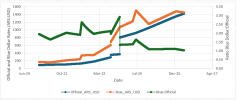
3) Below is a graph I made using Gemini to pull the Official and Blue Rate dollar exchange rates for the last 5 years. I also added a series which is the ratio of Blue Dollar to Official. You can see how much more in multiples or ratio, the blue dollar was. That difference was due to the government holding the peso at an artificially overvaluing the peso. That is was making thing relatively cheap to you as a foreigner with USD.
1776379782121.png
4) The previous administration had export limitations on cuts of meat which held the price of beef down. Those were lifting in January 2024 (Link to article Argentina Lifts Beef Export Restrictions). This made the price of beef jump as it was now partially being priced globally. This is when you started seeing more interest in Pork and chicken being advertised at Carnicerias in February 2024 because of the increase in price of beef, they were cheaper alternatives.
Milei also permanently reduced the export taxes in July 2025 (Link to article Reduction in Export Taxes). There were temporary exemptions in September when they were trying to manage the exchange rate.
Therefore, the increase in price of meat was not solely related to just the changed in the ARS:USD but more related to actual policy of opening the market to global competition. Yes its more expensive for the domestic population, but it also is better for the agriculture industry and FX of the country. Diets change. So beef was very much in fact "controlled".

5) Yes there was "fire power" during the election time. $2.5B of the $20B was used. Even with warning, multiple times they took it to 1550-1600 before the US Treasury dropped it back to 1380. So even with the warnings, and seeing it done, people were still betting against it. And as we see with the value of the dollar now, it wasn't warranted but it was emotional. The impacts that went on in the foreign exchange market brought the economy to a halt. It stopped the local credit market that restarted last year because it shot interest rates way up. There was effectively a 6 month pause in the economy.

6) The comment about where I am going with the pricing and inflation and goods and services....... Individual business owners get to decide the price they are willing to supply their goods and services to the market. Its up to them to decide if its too expensive for the market and they will result in 0 sales. It is up to the consumer to decide with whom they chose to purchase goods and services and how much they are willing to pay. If some service or good providers raise the price, and consumers decide they continue to need that good or service, then they will allocate money to that at the loss of other goods and services. So "who gets to decide which businesses can raise or lower prices?" was a response to the article about indec. Sure, transport went up, so yes, people will spend more there, and less elsewhere. Overall, since they spend all their income, if there is an 8% increase in Nominal spending, that is likely just due to increase in pay etc, and they spend it all.

7) Your comment of "BA not being Argentina" when I said "Again, this is no different than the rest of the world." I don't really understand how they are related. The rest of the world has inflation, so why there couldn't be in Argentina boggles my mind. I think you meant to respond to my edit where I say there is more to Argentina than BA, and I am stating that for those that are price sensitive, living in Mendoza or other secondary capital cities can reduce the cost of living, but still provide many of the same benefits of living in Argentina. I am amazed at the price difference sometimes between BA and the interior.

8) Milei talks about inflation reaching 0% (Recent quote - Milei reach 0). In the campaign last year he claimed "in 2026 there will be no inflation," (link - Milei Quote May 2025). If you can find the government inflation forecast for the budget for 2026 set at the end of the year, you will see that it was expecting it to reach 0 by about August. I was making the comment because it seems like Argentinians expects inflation to keep getting lower and lower or reach something like 0 or the 2 or 3% annual reported in other countries (or at least blame him for not achieving like he said he would) but that is unlikely a) because the other countries are not really just 2 or 3%, and b) the USD is also devaluing. So if things will be pegged to the USD, then accepting that the USD has devalued about 12% from Jan 2025-Jan 2026 needs to be considered why among other reasons the peso isn't getting that much weaker against it anymore. Similarly, the last few days the USD got weaker by a few percent against all currencies.

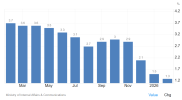
9) Japan's interest rate dropped in January but below you can see what it was last year (YoY presented monthly below). much higher than the 2% target which is why they raised the interest rates over the course of the year and this year (presented below). This is why there were some shocks in the stock market also earlier this year over concerns of winding down of the Yen carry trade which many use to fund investments in the US and other markets. This also is why the new Prime Minister Taikachi was elected and has a very pro spending policy plan to try and get the economy restarted, as I understand it. So the low inflation rate in Japan is a bit of concern for them and subsequently the rest of the world due to the impacts of raising Japanese interest rates on the carry trade and subsequently other markets.

10) To clarify, although mentioned above, the "all the hate" wasn't about a response to my comment, it was about the seeming hate and non-recommendation of retiring or living in Argentina. Just because the cost has gone up it is still a great place. If cost is your most sensitive or overweight determining factor, then maybe Argentina is no longer "the winner". But it is hardly a bad place to live. And before criticizing Argentina about the cost of living for a pensioner from the US, it is worth asking the question about the state of SS in the US and why one can't retire in the US after a lifetime of work and contributions. Its an unfortunate state of the system and government abuse. Similar worldwide though, not special to just the US.
1776381485346.png 1776381653998.png
 
Again, I did think the image was simple. Same USD / ARS conversion rate, both meat and petrol x 6 (in Pesos) since Mileinomics appeared. Nobody is conflating anything. Are you arguing with the data?
The image is very simple...USD purchasing power went down here. I don't think that's been lost on anyone. Now here's the bitter pill that most expats seem to refuse to swallow.

"Mileinomics" did not suppress the value of the dollar making your life more expensive. And no, there's no big bad central bank making your life miserable and no, there's no magic valuation of the dollar just around the corner that will make your life cheaper. This is no different than gold bugs and crypto bros swearing that the real value is xxxxx were it not for market manipulation and the valuation will blow sky high once enough people realize it.

Mileinomics fixed a distortion in the foreign exchange market caused by rampant fiscal mismanagement and speculation that expats took advantage of through arbitrage. That distortion has been removed and leveled the playing field between Expats and locals earning in pesos. Call that whatever the hell you want. Peso purchasing power has not been affected to the extent that USD purchasing power has, because unlike your Social Security payments, peso wages have actually increased in step with peso inflation. That's not to say that peso purchasing power hasn't kept up with domestic inflation, this can be said of virtually any national currency in it's respective country.

The original poster's question is asking about EXPATS using DOLLARS to buy PESO priced products and whether it's gotten MORE EXPENSIVE for EXPATS. The answer is a resounding YES. Please, for the love of our sanity, do not mention the INDEC or "residents". They have nothing to do with it.
 
The image is very simple...USD purchasing power went down here. I don't think that's been lost on anyone. Now here's the bitter pill that most expats seem to refuse to swallow.

"Mileinomics" did not suppress the value of the dollar making your life more expensive. And no, there's no big bad central bank making your life miserable and no, there's no magic valuation of the dollar just around the corner that will make your life cheaper. This is no different than gold bugs and crypto bros swearing that the real value is xxxxx were it not for market manipulation and the valuation will blow sky high once enough people realize it.

Mileinomics fixed a distortion in the foreign exchange market caused by rampant fiscal mismanagement and speculation that expats took advantage of through arbitrage. That distortion has been removed and leveled the playing field between Expats and locals earning in pesos. Call that whatever the hell you want. Peso purchasing power has not been affected to the extent that USD purchasing power has, because unlike your Social Security payments, peso wages have actually increased in step with peso inflation. That's not to say that peso purchasing power hasn't kept up with domestic inflation, this can be said of virtually any national currency in it's respective country.

The original poster's question is asking about EXPATS using DOLLARS to buy PESO priced products and whether it's gotten MORE EXPENSIVE for EXPATS. The answer is a resounding YES. Please, for the love of our sanity, do not mention the INDEC or "residents". They have nothing to do with it.

The issue is also his example also focuses specifically on Beef and Gasoline (petrol). Both categories had government policies to control the domestic price, so they weren't free market (real price) trading previously.
Beef I noted above in another post, and for gasoline the Milei administration allowed the refiners to raise the price to match the international market rather than just selling the oil abroad and also removing the requirement to first settle domestic demand at affordable prices (prices by government and the right of the government to interfere and prevent the exportation of oil).
https://www.energyconnects.com/news...e-oil-markets-by-law-in-shale-rich-argentina/

So these weren't necessarily subsidized, but they were controlled.
Subsidies were provided for gas.
 
The image is very simple...USD purchasing power went down here. I don't think that's been lost on anyone. Now here's the bitter pill that most expats seem to refuse to swallow.

"Mileinomics" did not suppress the value of the dollar making your life more expensive. And no, there's no big bad central bank making your life miserable and no, there's no magic valuation of the dollar just around the corner that will make your life cheaper. This is no different than gold bugs and crypto bros swearing that the real value is xxxxx were it not for market manipulation and the valuation will blow sky high once enough people realize it.

Mileinomics fixed a distortion in the foreign exchange market caused by rampant fiscal mismanagement and speculation that expats took advantage of through arbitrage. That distortion has been removed and leveled the playing field between Expats and locals earning in pesos. Call that whatever the hell you want. Peso purchasing power has not been affected to the extent that USD purchasing power has, because unlike your Social Security payments, peso wages have actually increased in step with peso inflation. That's not to say that peso purchasing power hasn't kept up with domestic inflation, this can be said of virtually any national currency in it's respective country.
With all due respect, you're overthinking this. The image was simple, simplify it further by ignoring the USD / ARS conversion rate, or treating it a a reference, or baseline. You're still left with a 6x price increase in some basic consumer goods.

The original poster's question is asking about EXPATS using DOLLARS to buy PESO priced products and whether it's gotten MORE EXPENSIVE for EXPATS. The answer is a resounding YES. Please, for the love of our sanity, do not mention the INDEC or "residents". They have nothing to do with it.
Apologies to the OP if I hijacked the thread, but threads do move on, and I'm responding to the latest arguments. I'm highlighting 6x Peso price increases. If you want to argue that "Peso purchasing power has not been affected to the extent that USD purchasing power has", then sure, I'll give you that, but do you think 6x Peso price increases are sustainable? I am fortunately not dependent on any sort of social security. Please don't project.

Mileinomics may have fixed a distortion, but has maintained, or introduced, others. Do we still have a "Cepo"? Of course. Is there a single, open-market exchange rate? No. Mileinomics will run only until it runs out of other people's money.
 
Back
Top