How much Argentine inflation really costs us?

Caribbean Cool

Registered
Joined
Jul 19, 2019
Messages
1,113
Likes
812
I needed to calculate how inflation affected my expenses over the 12 months ending May 2026. Here is how it works out. While Argentina’s 12-month consumer inflation through May 2026 was 33.2%, the official peso depreciated only about 21.8% over roughly the same period. That means Argentine prices rose about 11 percentage points faster than the official dollar during that year—important if you receive income in U.S. dollars. (Thanks ChatGPT)
 
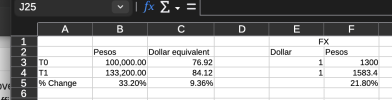
The math works out favorably for people paying in USD, no? Imagining a hypothetical basket of goods that cost 100k ARS at first and then 133.2k ARS later, expressed in USD terms with an FX rate that depreciated by 21.8% during the same period (starting arbitrarily at 1300 per USD though that doesn't matter) there's approx. 9% inflation in USD terms. Or am I misunderstanding?

Screenshot 2026-08-07 at 11.26.17 PM.png
 
Rent in Dollars of same apartment doubled for the duration of 2 years contract.
That's an annual inflation of 41.4%.
N.B. Rent nowadays is based on CPI.

Something is missing.
 
The math works out favorably for people paying in USD, no? Imagining a hypothetical basket of goods that cost 100k ARS at first and then 133.2k ARS later, expressed in USD terms with an FX rate that depreciated by 21.8% during the same period (starting arbitrarily at 1300 per USD though that doesn't matter) there's approx. 9% inflation in USD terms. Or am I misunderstanding?

View attachment 11060
Yes and no...those paid in USD are generally not given inflation adjusted raises like those earning in pesos. It would depend entirely on the employer of course. But think of it this way, can your foreign employer charging clients in USD pass on your local cost inflation of 33% to his clients that are living in a country that has an annual inflation of say 10%? Probably not...
 
I needed to calculate how inflation affected my expenses over the 12 months ending May 2026. Here is how it works out. While Argentina’s 12-month consumer inflation through May 2026 was 33.2%, the official peso depreciated only about 21.8% over roughly the same period. That means Argentine prices rose about 11 percentage points faster than the official dollar during that year—important if you receive income in U.S. dollars. (Thanks ChatGPT)
GPT's analysis is flawed...

First, dollar oficial is not what determines what rate you get on your dollar. CCL is probably closer and of course transfer fees take a bite of that to give you a net lower rate.

Second, the IPC here is a weighted average. Meaning your personal budget inflation may be higher or lower depending on your exposure to different sectors. The only way you can calculate your personal inflation is to track your personal costs across a time scale.

For example, my children's private school is my highest budget item. It increased 60% this year. My rent, my second highest budget item had a lease renewal this year and in addition to the quarterly IPC adjustments it was increased 20%, making a total annual inflation of 53.2%.
 
to your point #1.....I get payed at bank peso rate by law. #2 nonsense-no need to #3 I don't care about your school....nor your ipc contract rate Therefore....my figuring is close enough. Next problem.
 
The system used to calculate the CPI index is obsolete, based on 2004 criteria
The math works out favorably for people paying in USD, no? Imagining a hypothetical basket of goods that cost 100k ARS at first and then 133.2k ARS later, expressed in USD terms with an FX rate that depreciated by 21.8% during the same period (starting arbitrarily at 1300 per USD though that doesn't matter) there's approx. 9% inflation in USD terms. Or am I misunderstanding?

View attachment 11060

Excellent spreadsheet very clear USD inflation say 9 %.
 
Rent in Dollars of same apartment doubled for the duration of 2 years contract.
That's an annual inflation of 41.4%.
N.B. Rent nowadays is based on CPI.

Something is missing.
Any inflation index is based on a static measurement of currency. In Argentina the "IPC" tracks what 1 peso buys today vs tomorrow. In the USA the CPI tracks what 1 USD buys today vs tomorrow.

The problem with Expats is that they are trying to apply a dynamic measurement of currency (USD<--->Peso) to a static index (ICL), which is fundamentally flawed. Because your 1 peso today may be a different peso tomorrow depending on what your 1 USD is worth.

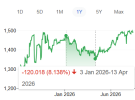
Here you can see that from January to April your inflation accelerated by 8%, and then decelerated from April to July.

1786327503080.png

This is why trying to calculate any annual inflation is a useless measurement for Expats because using an end of the year exchange rate value doesn't accurately reflect what the cost during the year actually was at the time of purchase.

Expats, who in the past could enjoy an exchange rate that always went up and largely kept pace with local inflation could reasonably plan a monthly budget. Today it's a crap shoot that only oscillates between "steady" erosion of USD purchasing power and "alarming" erosion of USD purchasing power.

 
Last edited:
Any inflation index is based on a static measurement of currency. In Argentina the "IPC" tracks what 1 peso buys today vs tomorrow. In the USA the CPI tracks what 1 USD buys today vs tomorrow.

The problem with Expats is that they are trying to apply a dynamic measurement of currency (USD<--->Peso) to a static index (ICL), which is fundamentally flawed. Because your 1 peso today may be a different peso tomorrow depending on what your 1 USD is worth.

Here you can see that from January to April your inflation accelerated by 8%, and then decelerated from April to July.

View attachment 11062

This is why trying to calculate any annual inflation is a useless measurement for Expats because using an end of the year exchange rate value doesn't accurately reflect what the cost during the year actually was at the time of purchase.

Expats, who in the past could enjoy an exchange rate that always went up and largely kept pace with local inflation could reasonably plan a monthly budget. Today it's a crap shoot that only oscillates between "steady" erosion of USD purchasing power and "alarming" erosion of USD purchasing power.
Where is Alfred E. Neuman when I need him?
 
Any inflation index is based on a static measurement of currency. In Argentina the "IPC" tracks what 1 peso buys today vs tomorrow. In the USA the CPI tracks what 1 USD buys today vs tomorrow.

The problem with Expats is that they are trying to apply a dynamic measurement of currency (USD<--->Peso) to a static index (ICL), which is fundamentally flawed. Because your 1 peso today may be a different peso tomorrow depending on what your 1 USD is worth.

Here you can see that from January to April your inflation accelerated by 8%, and then decelerated from April to July.

View attachment 11062

This is why trying to calculate any annual inflation is a useless measurement for Expats because using an end of the year exchange rate value doesn't accurately reflect what the cost during the year actually was at the time of purchase.

Expats, who in the past could enjoy an exchange rate that always went up and largely kept pace with local inflation could reasonably plan a monthly budget. Today it's a crap shoot that only oscillates between "steady" erosion of USD purchasing power and "alarming" erosion of USD purchasing power.

Economic analysis does not change facts.
Rent in Dollars (and every thing else) doubled in the span of 2 years = annual inflation of 41%.
Bottom line answer to OP question:
41%.
 
Last edited:
Back
Top