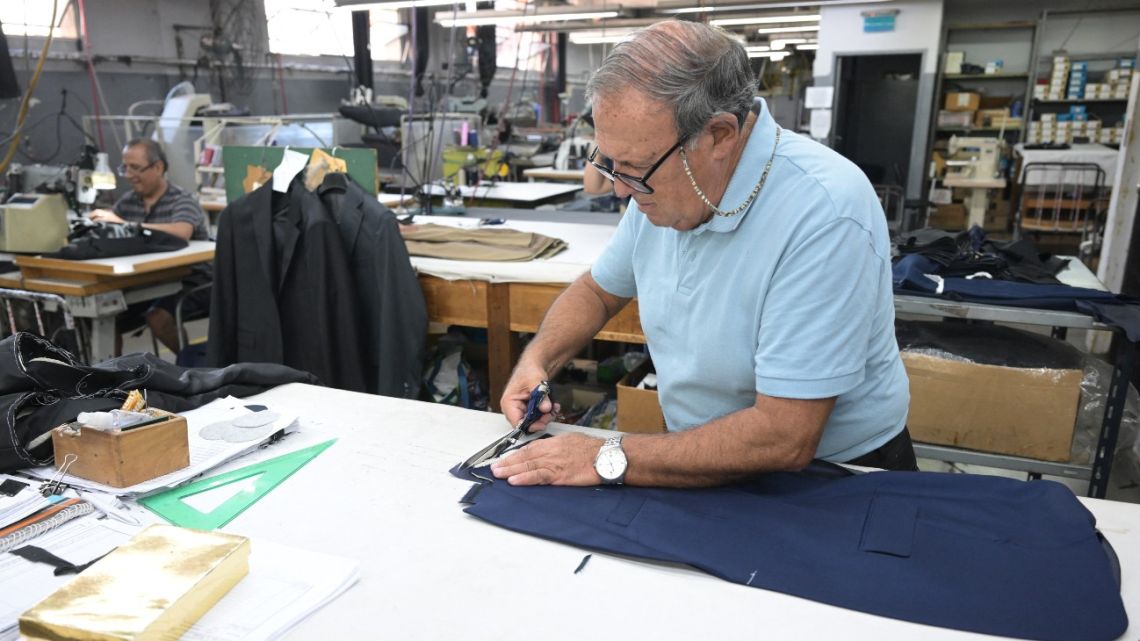
Argentina’s textile sector reels as import surge hits job

MilHojas

Registered
Joined
Oct 9, 2007
Messages
2,276
Likes
2,440
 
One has to wonder...if an Argentine buys clothes in China with $100,000 pesos, did money really flow out of the country? Did the china man take a textile worker's money?

The china man sold his clothes to the Argentine but now has a $100,000 pesos to get rid of. What can he do with it? He must buy something in pesos from Argentina to get rid of it. The china man buys soymeal for his cows from an Argentine soy producer. A zero-sum transaction.

Another scenario, the Argentine buys on Shein a shirt for $10. The BCRA sells you $10 for $18,000 pesos using the dolar tarjeta. Did the pesos leave the country? No, dollars did. You sold your pesos to the BCRA for dollars. The pesos stayed within the country. Again, a zero-sum transaction. You then used your dollars and sold them to the Chinaman for clothes. The china man used his dollars to buy US Treasuries. Did the textile worker lose dollars, then? Does an American lose dollars when he buys soymeal from Argentina? Does the textile worker then gain pesos from the soy producer who had to sell the dollars he made from the American to the BCRA for pesos?

Perhaps what matters at the end of the day is trade and whether it's a trade deficit or a trade surplus to really determine who is receiving more and who is receiving less. The sectors will shift depending on the trade.

When I see an article like this:


I begin to wonder which Argentine sector benefited and which sector lost. In a trade surplus, for every textile worker who lost, another worker should be winning more. Who are the Argentine winners in this trade surplus? Where is their story?

Of course, class warfare would have you believe the poor textile worker lost his pesos to the evil Argentine soy magnate. Can the evil Argentine soy magnate produce more soy without hiring more workers, purchasing more seed, fallowing more land, repairing more tractors? Questions abound. How can we manipulate this playing field? Can we cap how much the soy magnate can export? That means less trade surplus. Can we cap how many clothes get imported? That means less trade deficit. A zero-sum game.

How about this, can we stop all imports and only export things? That should produce a huge surplus and nobody loses, right? Except, nobody outside of Argentina now has pesos to spend. Argentina only has dollars from exporters, which must be either spent abroad or sold to the BCRA for pesos. Argentine producers are stuck only selling things to those who have pesos... which is other Argentines. Who is winning now? The evil soy magnate has gained more international market share, but what happened to the textile factory? Has the textile factory gained international market share? Has the tire factory gained international market share? A zero-sum game.

We won't know what the international market will do with their pesos until we give some to them. They will need to spend those pesos in Argentina, and perhaps new Argentine sectors will rise up to sell something to them for those pesos.
 
Last edited:
So let's assume that there is one pair of jeans in China and one pair in Flores. La Chiqui decides to buy the jeans in China. The pesos get converted to USD ,then to Yuan and the Chinese maker of the jeans can now take the money to buy his wife a spa day. He has not heard of Argentina except about Messi and would not know what to order from here with his money.
In the meantime there is a money investment in the Argentine jeans that is not being converted in anything in the Argentine economy and a second pair cannot be made as the money for the materials has not been earned. There is no other buyer as pesos are not circulating in the economy anyway. If La Chiqui had invested in the Argentine jeans it would have liberated pesos to buy a hair appointment for someone. But instead we now have uncut hair and a hairdresser sitting on dead time which he would have liked to use to take his talented son to football. But as that time was unpaid he cannot pay for that football practice. So you see what La Chiqui's preference for the Chinese jeans can do?
It could make Argentina's chances for the Worldcup in 2038 look shakey indeed..😁
 
So let's assume that there is one pair of jeans in China and one pair in Flores. La Chiqui decides to buy the jeans in China. The pesos get converted to USD ,then to Yuan and the Chinese maker of the jeans can now take the money to buy his wife a spa day. He has not heard of Argentina except about Messi and would not know what to order from here with his money.
In the meantime there is a money investment in the Argentine jeans that is not being converted in anything in the Argentine economy and a second pair cannot be made as the money for the materials has not been earned. There is no other buyer as pesos are not circulating in the economy anyway. If La Chiqui had invested in the Argentine jeans it would have liberated pesos to buy a hair appointment for someone. But instead we now have uncut hair and a hairdresser sitting on dead time which he would have liked to use to take his talented son to football. But as that time was unpaid he cannot pay for that football practice. So you see what La Chiqui's preference for the Chinese jeans can do?
It could make Argentina's chances for the Worldcup in 2038 look shakey indeed..😁

This assumes both jeans are equal. In reality they are not of equal quality or price. So if one can buy $10(15,000 pesos) jeans from China, instead of $100 (150,000 pesos) jeans from Argentina, the buyer, La Chiqui, now has the remaining $90 ($140,000 pesos) of disposable income that can now be spent on something else, hair cuts, restaurants, electronics, more clothes, investments, etc. There will be various different indirect jobs, the cotton supplier etc, vs the individuals that work at the ports,logistic companies, customs brokers, importers, etc.
It is not as straight forward a simple calculation as one might think.

But the larger impact is that $140,000 pesos of additional savings that can be spent on other things. The expectation is that will help spur the economy. When one considers that the entire textile industry and its supply chain is 500,000 people (per article this week quoted in one of these threads), it is not disappearing completely. In the last 2 years, about 3% of jobs were lost across the entire industry and a reduction of 3-3.5% production capacity. So while there were about 15-18,000 jobs lost, the rest of the country, ~47 million people now save significantly more on clothes and can spend on other things. It isn't a 1:1 because the ratio of population to textile industry related jobs is ~94:1. So instead of 1 employee within the textile value chain gonig for a haircut, much more of the general population can now go for hair cuts and more.

It is this logic that has supporting global trade over the last ~40 years, resulting in the global economy growing and maximizing consumption of goods and services.

To LuckyLuke's points/questions, they touch on the same logic etc.
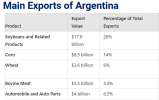
The soybeans and soy related, corn, wheat, beef are the major exports.
The values in the table below are from 2023, and the amounts have increased since.
Overall there was about $12B trade surplus in 2025, driven by agriculture. These values increase not just because of quantity but because the global price has gone up.

Net surplus or deficit will support or put pressure on the peso. That is where you will see overall impact.

It was noted last year, that the agriculture industry has the fastest payback and most immediate impact per investment.
Their impact can be 1yr away, where as oil and gas, mining etc can take years for new projects or even expansions of existing to reach production.

The industries are not related to each other so there is no zero sum between them.
Individuals need to make a decision if they lose a job in their jurisdiction to move to another jurisdiction to get a job.
This does happen. I have seen people frequently live in one province nearby (Mendoza), or not, (Cordoba, Tucuman, another one in the south) where they transport on their time and expense (airplane flightS included) to get to their pick up location for their jobs.

I have been told that due to the previous protectionist policies, farms in Argentina are extremely resourceful and have incredible workshops apparently that North American farmers would be jealous of mainly because they needed to maintain and repair everything themselves since it was not easy for them to get parts imported. Now with importing much easier, they can upgrade equipment size and get newer equipment to improve productivity.

Also due to the protectionist policies, Argentina is quite capable in producing much within the borders not relying on imports. As this has been relaxed, they are becoming more reliant on imports, but that has also brought with it significant savings in the price of appliances etc, which again can now be spent on other things.

With regards to Argentinians increasing international market share, I think that would be industry specific.
As climate permits (I believe prior to 2024 they suffered from drought etc lowering yield), and increasing prices, and sound tax policy, the agriculture will typically reinvest what they can to increase next years crops. This is among the reasons why they give them the reduced/eliminated retentions on FX, among helping shore up reserves, it also provides them with increased profits (so instead of witholding/retentions off the top, they pay more income tax), but works out a bit better for them so they can now invest more in next years crops. Argentina's ability to increase market share can be a result of external trade policies (ie, US), but similar to OPEC cartel members not obeying quotas, if the market is oversupplied the volume may still get sold but the price may go down. I think the marketplace is large enough and individual participants are acting independently in their own self interest.

In regards to the other industrial industries in Argentina, I don't think Argentinian textile companies were trying to grow internationally, as their pricing was supported by protectionist policies. There was no way they could compete on price, and it doesn't look like on quality for mass produced goods. Specialty leather goods etc may be a separate or sub industry. The tire company that closed, I thought the family had mentioned, they had gone bankrupt in 2019, and had been losing money for 30 years. I don't really understand how a business can be losing money for 30 years and remain in business. I understand the different between PnL and cash flow, but 30 years is a long time. They may have had other companies and were able to shift profits around, ie, rent the property, building, equipment to themselves, so the tire manufacture may be operating at a loss, but the other companies are operating at a profit. I thought I heard they have had some labour dispute issues but I don't know the details.

Typically, people like to look at GDP growth as the indicator that overall policy is positive, but the issue is that inflation also makes the absolute number get bigger (Nominal GDP). So the question becomes is there real growth or not. and not just that, but how is it distributed. Is it concentrated to a small elite class, or distributed amongst the population. I think its important to 1) look at where on the spectrum is the news source one reads and be aware of biases, 2) remember the squeaky wheel gets the grease, just because they are the loudest voice doesn't necessarily mean they are representative of the general population, 3) CABA and BA Province, have populations of 3.1M (7%) and 17.5M (38%) respectively, and the population of Argentina is 46M. it is worth remembering that CABA, or the Province of BA, are not representative of the country as a whole. That is a reason why the politics are as fragmented with other regions being more conservative leaning and economies based on very different things.

1771559075099.png
 
this article is full of baloney.
Caputo undoubtedly has no idea where all of his clothes come from, as I am sure some woman in his life buys his socks, t shirts, undewear, etc.
He is rich, has terrible taste in name brand, but not particularly high quality clothing. I am sure he buys Patagonia puffies, which sell for roughly triple what a perfectly decent brand from Mar de Plata does.
His suits look like he buys them at mens warehouse.

then, they contrast that with a woman in the provincias who is poor enough that she buys used clothes from the USA, via China, by the kilo.

Neither really represents whats going on with the textile industry.

The chinese are bringing in very low cost, very low quality clothing, and its taking a big bite out of the lower half of the industry.
Part of this is because Milei is so scattershot in his import policies.
Its still very expensive for most imports.
I just imported a sewing machine late last year, and while you may be able to buy some things direct on Amazon, the average small business is not helped at all- I had to pay a relatively small duty, but also, IVA, at 21%, a customs broker as I am not a Nivel 3 business, and, incredibly, DHL Argentina charged me 300,000 pesos for "processing" an already prepaid DHL shipment.
I bought the exact same machine, one year previously, in the USA, before tariffs, and there were zero additional charges.
The Argentine government created all the laws and regulations that make it cost close to double for small businesses to import anything.
And they have done zero to change them.

As far as jeans go- I have been wearing Ombu, argentinan made work clothing, in my metalworking shop, for 15 years.
Currently, online, a pair of jeans from Ombu is 32,000 pesos- about $23 today at the current dollar exchange rate.
Thats about half what I pay at Amazon in the USA for an equivalent pair of made in Mexico wrangler denim work pants.
I wear levis 512s and 511s a lot- both are usually $50usd to $75 Usd, depending on fabric and color, on Amazon in the USA.
Sure, the imported levis are more here, but quality made in argentina jeans are half the price of US jeans in the US.

My wife bought me some nice J crew T shirts in the US last year, to wear on occasions where I need a "nice" T shirt.
J crew is NOT high fashion, or particularly expensive, in the US- and their T shirts are about $35 each- 50,000 pesos.
I can get high quality argentine T shirts for less.
Or, I can get basic, thin, argentine T shirts for 8000 or 10,000 pesos. You buy 5000 peso chinese ones, expect them to fall apart within a year.

The problem I see with Argentina, always, is the tax structure, which doesnt tax the wealthy, the scattershot import rules and duty, and the lack of an industrial policy that supports industry.

Argentina is one of the very few countries in the world that has a complete top to bottom textile industry, and neglecting it is a crime.
We grow the cotton, raise the wool, as well as llama and vicuna, spin the threads and yarns, weave the fabrics, manufacture the findings, zippers, grommets, and snaps, design, sew, and market the clothing. We also have a top to bottom shoe manufacturing industry, including factories that make soles, heels, laces, leather and synthetics, and manufacture every type of shoe, and boot, and sandal.
A small amount of government investment, as well as streamlining of export rules, could result in a lot more exports.
 
a few points:
1) Argentina taxes everyone and there is the asset tax. To the point that many Argentianians have left, or changed their residency to Uruguay. So trying to further tax a smaller group of people will work against its objective. This has been studied in many other countries. There needs to be a balance.
2) The head of the Argentinan textile industry goes on to say how much taxes are for the industry and then includes IVA and others. Most of these are present in other countries as well. Fundamentally, the hardest taxes on businesses of all sizes are the taxes on Gross Sales which include: Provincial taxes 3-5%, the taxes on crediting and withdrawings from accounts (1.2% for digital transfers (0.6/0.6), 2.4% for cash (1.2/1.2)).
3) Payment costs, while 0 for transfers, are more expensive for debit and credit card processing. The processors charge for both processing and giving you the money, they prefer to hold it and make the interest than give it to you.
4) They can setup a 0% tax zone for factories that export only and in fact there is one being setup in San Juan. If exporting then I assume credits for IVA (VAT) can be applied for or just not included for example by issuing a Factura E
5) The tax code needs a reform, but I think it largely needs to focus on the provincial taxes. They need to switch from Gross based to income or property based. I am not sure the case in Buenos Aires, but in other parts of the country the property tax is really not much, whereas in many countries it is 1-3.5% of property value.
6) The other major issue regarding taxation in Argentina is the informal economy and lack of enforcement on taxation. The economy needs to be transformed to be completely formal. For the left to keep ignoring this and suggesting just raising the taxes on the rich is a major problem.

An issue all businesses face here is the lack of a credit market. Both high interest rates and accessibility. This was being addressed last year until everything starting going crazy in August around elections and didn't get restarted until I think January of this year. Everything is paid for in cash, as opposed to some form of credit or longer terms to pay. This causes a lot more friction and higher costs all throughout the value chain.

Additional points:
1) Costs of logistics for business importing and exporting is far cheaper than what you are mentioning with small packages. Having a proper freight broker will bring costs down substantially, and for large shipments, the cost of shipping containers, up to 24t, results in negligible logistics costs on a unit basis. This is what allows the world the distributed and offshore supply chain to be so successful.
2) The protectionist taxes is what has enabled the full supply chain you mention to exist.
3) They have been reducing taxes to import.
4) The government doesn't have enough seats to pass whatever they want, and they had even less in the first 2 years. Not removing all these taxes and doing them in 1 step was not even a realistic option.
5) Comparing between reasonably comparative levels for prices would still indicate Argentina is more expensive. If you want to compare Patagonia, North Face, Osprey, etc, then compare it against Ansilta. Ansilta is far more expensive.
 
a few points:
1) Argentina taxes everyone and there is the asset tax. To the point that many Argentianians have left, or changed their residency to Uruguay. So trying to further tax a smaller group of people will work against its objective. This has been studied in many other countries. There needs to be a balance.
2) The head of the Argentinan textile industry goes on to say how much taxes are for the industry and then includes IVA and others. Most of these are present in other countries as well. Fundamentally, the hardest taxes on businesses of all sizes are the taxes on Gross Sales which include: Provincial taxes 3-5%, the taxes on crediting and withdrawings from accounts (1.2% for digital transfers (0.6/0.6), 2.4% for cash (1.2/1.2)).
3) Payment costs, while 0 for transfers, are more expensive for debit and credit card processing. The processors charge for both processing and giving you the money, they prefer to hold it and make the interest than give it to you.
4) They can setup a 0% tax zone for factories that export only and in fact there is one being setup in San Juan. If exporting then I assume credits for IVA (VAT) can be applied for or just not included for example by issuing a Factura E
5) The tax code needs a reform, but I think it largely needs to focus on the provincial taxes. They need to switch from Gross based to income or property based. I am not sure the case in Buenos Aires, but in other parts of the country the property tax is really not much, whereas in many countries it is 1-3.5% of property value.
6) The other major issue regarding taxation in Argentina is the informal economy and lack of enforcement on taxation. The economy needs to be transformed to be completely formal. For the left to keep ignoring this and suggesting just raising the taxes on the rich is a major problem.

An issue all businesses face here is the lack of a credit market. Both high interest rates and accessibility. This was being addressed last year until everything starting going crazy in August around elections and didn't get restarted until I think January of this year. Everything is paid for in cash, as opposed to some form of credit or longer terms to pay. This causes a lot more friction and higher costs all throughout the value chain.

Additional points:
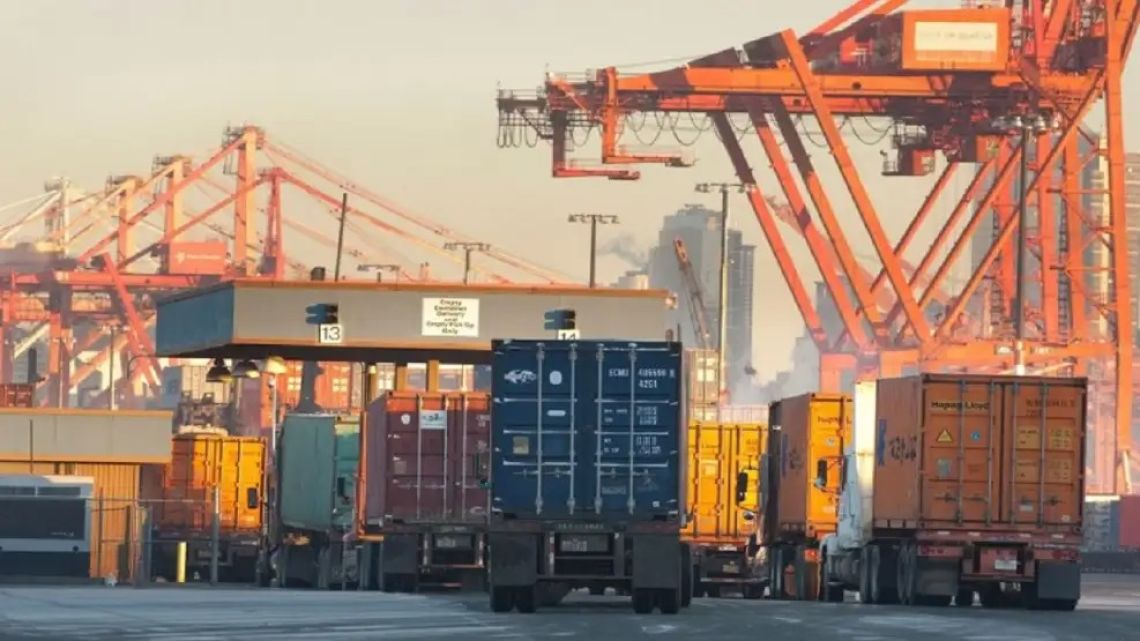
1) Costs of logistics for business importing and exporting is far cheaper than what you are mentioning with small packages. Having a proper freight broker will bring costs down substantially, and for large shipments, the cost of shipping containers, up to 24t, results in negligible logistics costs on a unit basis. This is what allows the world the distributed and offshore supply chain to be so successful.
2) The protectionist taxes is what has enabled the full supply chain you mention to exist.
3) They have been reducing taxes to import.
4) The government doesn't have enough seats to pass whatever they want, and they had even less in the first 2 years. Not removing all these taxes and doing them in 1 step was not even a realistic option.
5) Comparing between reasonably comparative levels for prices would still indicate Argentina is more expensive. If you want to compare Patagonia, North Face, Osprey, etc, then compare it against Ansilta. Ansilta is far more expensive.
Less than 100,000 people, out of over 40 million, qualify to pay personal income tax.
There is no actual property tax.
I have been a property owner here for almost 2 decades. In CABA, there is ABL, which is actually a garbage collection and sewage fee, not a property tax per se. Then, there is Bienes, which most property owners dont qualify for, as its based on your purchase price.
There is no property tax that goes into the general fund, as in the USA.
Just as a point of comparison, in BA, property taxes, several kinds, are under 2% of the city budget. In NYC, its 44% of the annual city budget.
There is no inheritance tax. Doesnt matter if you are leaving behind a 25,000 hectaire estancia, or a skyscraper downtown. no tax.
The tax system is 3 legged- a bit less than a third of government tax income is export taxes. another third is withheld from workers salaries, and the last 3rd is IVA. Then there is a very small amount of corporate taxes, and as mentioned, a tiny trickle of income taxes.
IVA here is quite high- Japan, for example, has half the rate, as do many other countries. IVA and the wage taxes are all quite regressive, with the lower and middle classes paying the majority of it.
And taxing exports is just stupid. Virtually no other country does this, as, obviously, it is a job killer, and very bad for the balance of payments from abroad.

I have actually paid customs brokers here, and no, they dont save you money- they cost you money.
I have also used customs brokers as needed in the USA, to clear ocean shipments and some air shipments.
Have you used a customs broker? How did the costs compare to in whatever your home country is?
As I said, I imported the exact same machine, for the same base price, with the same prepaid shipping, in the US and Argentina.
The fricitonal costs in Argentina basically double the cost of imports, and, stupidly enough, many of those same costs apply to exports.
All of those hidden frictional costs are benefitting people who are stifling the industrial base here, and none of those costs, in reality, have dropped in the 17 years I have been here, no matter who the government is.
 
I have never heard of ansilta, so I looked it up- technical climbing gear.
I compared the puffy jacket from ansilta, which is $230 at todays rate, with the equivalent Patagonias, in the US- and they range from $249 to $379. I used to live in Ojai, up the road from Patagonias headquarters, and have been buying seconds and sale Patagonia for 35 years, and it is not cheaper than Ansilta. People like Caputo are not buying Patagonia to climb mountains, its a fashion thing. And theres a ton of "fashion" grade puffer jackets on mercado libre for under 100,000 pesos. Some for 50,000 pesos. NO, they arent Patagonia, but they arent $300USD, either.
Lots of reasonably priced argentine clothing is far cheaper than name brand global stuff.
 
Less than 100,000 people, out of over 40 million, qualify to pay personal income tax.
There is no actual property tax.
I have been a property owner here for almost 2 decades. In CABA, there is ABL, which is actually a garbage collection and sewage fee, not a property tax per se. Then, there is Bienes, which most property owners dont qualify for, as its based on your purchase price.
There is no property tax that goes into the general fund, as in the USA.
Just as a point of comparison, in BA, property taxes, several kinds, are under 2% of the city budget. In NYC, its 44% of the annual city budget.
There is no inheritance tax. Doesnt matter if you are leaving behind a 25,000 hectaire estancia, or a skyscraper downtown. no tax.
The tax system is 3 legged- a bit less than a third of government tax income is export taxes. another third is withheld from workers salaries, and the last 3rd is IVA. Then there is a very small amount of corporate taxes, and as mentioned, a tiny trickle of income taxes.
IVA here is quite high- Japan, for example, has half the rate, as do many other countries. IVA and the wage taxes are all quite regressive, with the lower and middle classes paying the majority of it.
And taxing exports is just stupid. Virtually no other country does this, as, obviously, it is a job killer, and very bad for the balance of payments from abroad.

I have actually paid customs brokers here, and no, they dont save you money- they cost you money.
I have also used customs brokers as needed in the USA, to clear ocean shipments and some air shipments.
Have you used a customs broker? How did the costs compare to in whatever your home country is?
As I said, I imported the exact same machine, for the same base price, with the same prepaid shipping, in the US and Argentina.
The fricitonal costs in Argentina basically double the cost of imports, and, stupidly enough, many of those same costs apply to exports.
All of those hidden frictional costs are benefitting people who are stifling the industrial base here, and none of those costs, in reality, have dropped in the 17 years I have been here, no matter who the government is.

1) You say that 1/3 of revenues are from workers withholdings and then say only a small number comply. From a quick google about 800k-1M pay income tax. or about 10% of the formal workforce (are the high earners). The fact is in the US only 50% pay federal tax because their income is too low as well. Its not really different globally, just a bit more skewed here but not unexpected amongst other developing nations. The professionals and higher earners do in fact pay. And certain industries pay their employees well above the averages (mining). Again, the point is to get them registered then in the system if they aren't paying anything anyways. The issue is that with that comes more overheads for pension/medical etc. The fact that the governments budgets are balanced currently, indicates there isn't massive amounts of new funds required. Yes they need to start projects again which are coming through loans from Interdevelopment Bank, and negotiations with the governors etc. In the future, if they can maintain responsible governance they can return to debt issuance to manage slight deficits like every other country.

2) My point is that the tax reform needs to transfer the source of taxes for provincial services from Gross Sales based to shared income tax or institute a real property (or land value) tax. These gross taxes are a huge component 5% of sales vs profits. This is why I am saying instead of them coming from businesses it should be coming from property owners. It can get passed on to tenants. No problem with that as it is a cost to operating/owning the unit. Does property tax not cover education, health care, police, garbage collection in the US and other jurisdictions?

3) IVA - this is an interesting one here, because it should be based on the category of good or service not just the type of business structure offering it (monotributos don't need to pay IVA to government but SAS, SRL, SA do). Nevertheless, I believe by issuing a Factura E invoice for sales to foreign entities you do not need to pay IVA. Factura E can be issued by monotributos also. But yes agreed, exports shouldn't be charging IVA.

Shipping
Yes I have used brokers etc in the country. Freight is far cheaper with actual logistics companies at less than $10/kg instead of the $40-50/kg quotes by the retail companies. Shipping large containers for up to 24t can cost ,$6k depending on source/destination. If you are located near BA or ports then your in country logistics will also be reduced. Different industries have different importation rights etc.

Yes the import duties benefit the industrial base here, They are protectionist policies that raise the cost (no difference than anywhere else in the world that implement them). This is part of the issue with the textile industry. It was very well protected.

The agriculture industry isn't charged export tax as I understand but rather a withholdings on the money coming in. I guess that is essentially the same. But the governments often offer windows of exemptions or lower withholdings, and they also offer them a different exchange rate. The larger producers that make up I think like 80% of the market have huge silos and warehousing capacity, so they often wait for these periods to get the benefits (similar to around election time).

The price for the Argentinian made goods all fall on the higher end of the spectrum, regardless of reason someone may buy them (fashion or technical need). Amongst the reason why is literally you mentioned in your post of the taxes and importing costs (do they use YKK zippers or a national brand?). What people are willing to pay will set the value particularly for non-necessity items. This is no different than Canada Goose jackets going for 1000s and then going for cheaper when people don't have the disposable income anymore, or cheaper versions of similar quality come out. Look at Lulelemon getting smashed with lower demand for their goods with people buying direct from China now through Aliexpress, Temu etc.

I think in Canada you can go to costco and get Levi's 505 jeans for $30, so about $22 USD. Kirkland branded for $20-30 CAD ($15-22USD). You will not find anything remotely close for the price here. Yes that is costco not a fashion house, but still between them, Target, Walmart, Marshalls, Winners, etc there is ample clothing distributors at affordable prices. Here I find much thinner denims, and the stitching to be far weaker. Yes there are some brands that make better quality, but I am talking about widely and easily available good quality. And since those brands similar to what you have mentioned do exist here, it is not impossible. It just comes a point in time when the business owners resign to the fact that the old protectionist policies are gone, at least for their industry, and embrance it. Like I mentioned before, it is not uncommon for coal mine owners or other miners to suggest that they will have to shut down due to environmental policy, taxation, other fees, etc and then the governments typically cave in or provide some incentives etc. Same with car manufacturing etc. Here, the textile owners are doing this to see if the government will flinch. If not, they will adapt. In the meantime, some will lose their job. And I know that sounds cold, and I really do feel sorry for the workers that lose their job. But it is a reality of changing economy. When Walmart was growing, how many small business closed? When Amazon grew how many shopping malls and plazas saw much less traffic (now some are selling department anchor space for warehouse to Amazon)? With the growth of Uber Eats/Doordash/ Pedidos Ya, how much less waiting staff/Tips are paid vs something to the delivery person? Coal miners used to go with a pick axe and wheel barrow, mining trucks were normal dump trucks. Now they have continuous mining at more than 10-15k tonnes per hour, and individual trucks that can carry 400+ tonnes of material per load, so 1 truck in place of 15 small ones.


Ansilta Goretex light jacket (644,000 Pesos , @1390ARS/USD = $463)
Other Gore-Tex shells ranging from $175-400
1771884715310.png

1771884622173.png

1771884865386.png
 

Attachments

  • 1771884699710.png
    1771884699710.png
    147.2 KB · Views: 0
Back
Top