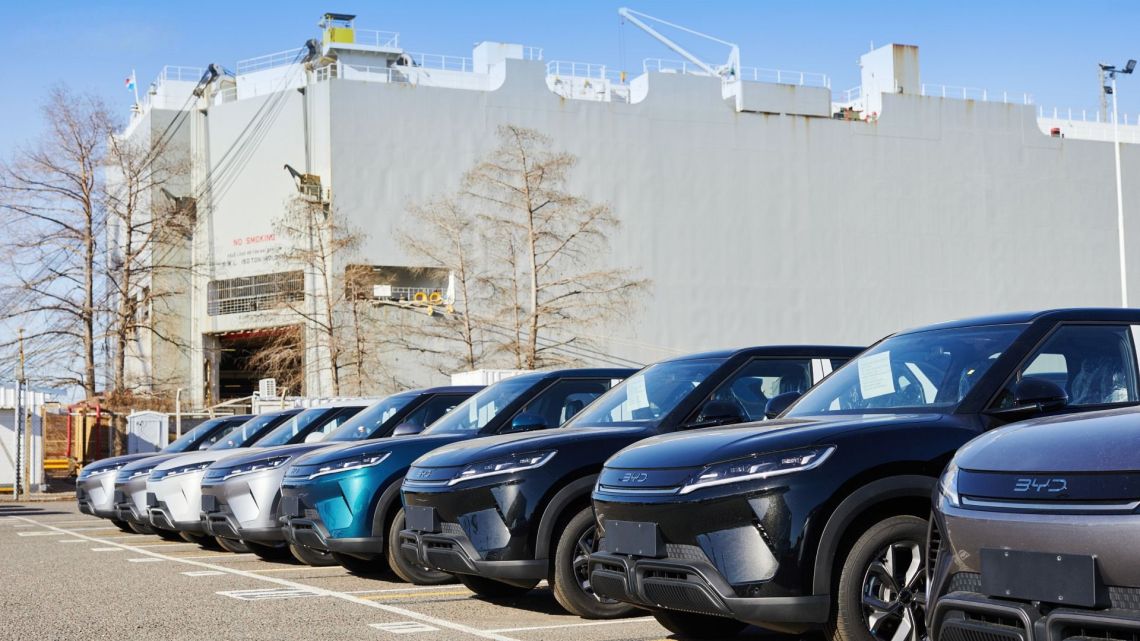
Chinese EVs are everywhere in Argentina

New cars owners do not look for mechanics. They go to the dealership for at least the length of the warranty. For BYD in Argentina that is eight years. Really who needs a mechanic for any new car, except for scheduled maintenance, during the first 8-10 years?


WhatsApp-Image-2026-06-29-at-13.31.41.jpg
 
Having owned an electric car in the USA for 8 years or so, I would say he is living in the same world we live in. Our electric car has been virtually maintenance free. They do need tires every once in while, but the list of stuff they dont have, and hence, cant break, is long- no oil, no coolant, no exhaust system, no fuel pump or tank, no transmission, no alternator, no hoses, no pumps, no cat convertor, and since you dont actually use the brakes (regenertive braking means when you take your foot off the gas, the motor spins backward charging the battery, and you almost never use the brake pedal), the brake pads outlast IC car brake pads by double or triple.

So mechanics are kinda a thing of the past. Most anything that will go wrong would require hooking up to BYD dealership computers, as all the (non-moving) parts are basically a computer.

Plus, since the chinese evs cost about 2/3 of the cost of their IC competitors, Argentines are already saving the costs of a lot of mechanic visits.

Uruguay, which is a couple years ahead of Argentina, in terms of ev adoption, has charging stations everywhere. In Montevideo, the city has installed a ton of them, as its much more desirable to use Urugayan generated electricity than to import expensive gas.
We were in Uruguay earlier this year, and in the metropolitan area, electric trucks, up to the 5 ton 30' flatbed size, are everywhere- the ideal city delivery vehicle, as they go home to their charger every night.
and I am seeing more and more of them in BA these days as well. They cost the same, or often, less than diesel trucks, and then, upkeep and fuel are a tiny fraction of the normal costs. We will be seeing a LOT more delivery vehicles go electric, at least two chinese companies are now assembling them in Argentina from chinese components now, and unlike cars, where there is a lot of fashion involved, a 3 ton cabover flatbed is going to be bought unemotionally and entirely on the numbers, and the numbers are very weighted towards the EVS.

 
Good point about the maintenance costs. We've had to invest a bit this year in our Volvo SUV (it's on 240k km and will probably go to the moon and back with some maintenance), nothing major expect for a disc brake that underwent rapid unscheduled disassembly (the unmentionable sods who previously owned the car had skimmed the discs), but it all mounts up, suspension parts due to the bad roads and potholes, I need to get a new set of tyres sometime, I think they sprinkle screws and nails on the roads here, it's all just accumulated I guess.

The problem remains the charging stations, there's one out here 20 mins away at the YPF just south of Campana. More in CABA, of course, but it's still not a very dense network. I would not be going full electric for some time.
 
electric cars make the most sense for people who have a garage or yard where they can park and charge every night.
and electric trucks or buses make sense when you can be home in the warehouse or yard every night to charge.

so long distance uses are the last to electrify.
This is true everywhere, not just in Argentina.

The Estancia owner who routinely makes a 6 hour each way drive to the city in his big VW Amarock will not go electric any time soon.
Long Haul truckers going to Salta or Bariloche- no.
The delivery man who goes to the neighborhood Kiosko 3 times a week- yes.

the people who live in Belgrano R, and drive their car 3 or 4 times a week, but take the bus or subte to work every day- they are going to save 30% or more, and they are the prime BYD customers.
 
Some of us remember some time ago, maybe 8, 10 years ago with the boom of buying ac units(ac para todos)the grid couldn't keep up with the demand provoking large portions of the city to be in complete blackouts weeks on end, so the question is, how many of us are sure that the grid , not only was repaired. but also expanded to be ready for this type of demand?
I'll just stick to my 33 year old jeep for now and see how this works out
 
Some of us remember some time ago, maybe 8, 10 years ago with the boom of buying ac units(ac para todos)the grid couldn't keep up with the demand provoking large portions of the city to be in complete blackouts weeks on end, so the question is, how many of us are sure that the grid , not only was repaired. but also expanded to be ready for this type of demand?
I'll just stick to my 33 year old jeep for now and see how this works out
Peak grid demand is during the daytime, most EV owners charge overnight once they arrive home and plug in. In the US and other countries with higher EV adoption there is the option for "Time of Use" rates, where you have a discounted electricity price for the power you use overnight, as that's when demand is low, the power companies would rather sell at discounted prices than idle their power stations just to turn them back on the next day, so the impact will be less than you'd think.

As an EV driver in the US it does require a change in your mindset, people are not "filling up the tank" every week or two so to speak, with an EV you plug in every day. It's more like "topping off" in that you charge only what you drove that day. For most folks that's around 40 miles or so, so charging times are less of a concern as well.

Echoing the comments above, EVs require basically no maintenance at all. After 8 years of driving the only thing that's needed changing is the tires, my car is still on the original brake pads!
 
Back
Top