Digital Nomads: does Lisbon have any lessons for Buenos Aires?

elhombresinnombre

Registered
Joined
Sep 25, 2008
Messages
1,947
Likes
1,778
Portugal and Argentina started their Digital Nomad visas within a few months of each other but Portugal's appeal has been massively more successful than any other similar scheme. One digital nomad in Lisbon talks about their experiences. Are there any lessons here for Buenos Aires?


You don't need an archive link for a free-to-read article but here it is anyway: https://archive.is/0nFd4
 
Portugal and Argentina started their Digital Nomad visas within a few months of each other but Portugal's appeal has been massively more successful than any other similar scheme. One digital nomad in Lisbon talks about their experiences. Are there any lessons here for Buenos Aires?


You don't need an archive link for a free-to-read article but here it is anyway: https://archive.is/0nFd4
Not just Lisbon, but Spain and Mexico have seen significant protests by locals recently against digital nomads driving up their housing costs and overstepping their welcome.


Buenos Aires/ Argentina would do well not to let it get out of control lest the comparatively "cheap" housing costs Argentina still enjoys starts pushing out local wage earners just like they are doing in Portugal, Spain, Mexico and elsewhere.
 
Do not apply for DNV unless you plan to stay 1 year and no more in Argentina.
 
Not just Lisbon, but Spain and Mexico have seen significant protests by locals recently against digital nomads driving up their housing costs and overstepping their welcome.
AS far as I can tell, it's not in Portugal, Spain or Mexico in general there are problems.
The problems I have seen are about tourists visiting, and expats moving to, a few of their cities in overwhelming numbers, millions of visitors in popular towns with thousands of locals.
 
AS far as I can tell, it's not in Portugal, Spain or Mexico in general there are problems.
The problems I have seen are about tourists visiting, and expats moving to, a few of their cities in overwhelming numbers, millions of visitors in popular towns with thousands of locals.
It is city specific in those countries as you point out but the discontent is primarily driven by expats/ digital nomads with higher cash incomes than locals (often thanks in large to being temporarily tax and social security free) putting an extra strain on a finite housing markets, increasing competition for available units and thus driving up prices for locals who don't enjoy the same economic privileges. Some cities like Barcelona or regions like Mallorca also have the added layer of short term tourists placing strains on public infrastructure, tranquility and short-term AirBnBs further eating up housing supply as they have become victims of their own success, resulting in parallel "Tourist go home" movements.

For example how many digital nomads/ expats would choose to live in Evora when they could live in Lisbon or Porto which at least have shops open on weekends? Same would be the case for Argentina, if it had the comparable numbers of digital nomads as Spain, Portugal or Mexico for example. Would imagine that very few of the total digital nomads the country attracts would select (or even consider) cities like Mendoza or Cordoba over the bright lights of Buenos Aires, thus naturally these national level DNV programs almost always concentrate the "harm" (and conversely any "benefit") that they may cause in one or few cities/ regions.

"Guiri go home" or "Gringo go home" movements are targeted at digital nomads/ expats who don't have local jobs and don't pay local taxes as the locals do but live side by side with locals competing for the same resources. For such social movements, digital nomads/ expats are simply "colonizers" who directly or indirectly depend on exploiting locals to maintain their own lifestyles and economic wellbeing at a level above what they would otherwise enjoy in their home country.
 
It is city specific in those countries as you point out but the discontent is primarily driven by expats/ digital nomads with higher cash incomes than locals (often thanks in large to being temporarily tax and social security free) putting an extra strain on a finite housing markets, increasing competition for available units and thus driving up prices for locals who don't enjoy the same economic privileges. Some cities like Barcelona or regions like Mallorca also have the added layer of short term tourists placing strains on public infrastructure, tranquility and short-term AirBnBs further eating up housing supply as they have become victims of their own success, resulting in parallel "Tourist go home" movements.

For example how many digital nomads/ expats would choose to live in Evora when they could live in Lisbon or Porto which at least have shops open on weekends? Same would be the case for Argentina, if it had the comparable numbers of digital nomads as Spain, Portugal or Mexico for example. Would imagine that very few of the total digital nomads the country attracts would select (or even consider) cities like Mendoza or Cordoba over the bright lights of Buenos Aires, thus naturally these national level DNV programs almost always concentrate the "harm" (and conversely any "benefit") that they may cause in one or few cities/ regions.

"Guiri go home" or "Gringo go home" movements are targeted at digital nomads/ expats who don't have local jobs and don't pay local taxes as the locals do but live side by side with locals competing for the same resources. For such social movements, digital nomads/ expats are simply "colonizers" who directly or indirectly depend on exploiting locals to maintain their own lifestyles and economic wellbeing at a level above what they would otherwise enjoy in their home country.
I loath BsAs (where I started in 2002) and love Mendoza, which in many ways is a much more pleasant and friendly city. Mendoza has everything you need, and what most people want.
 
"Guiri go home" or "Gringo go home" movements are targeted at digital nomads/ expats who don't have local jobs and don't pay local taxes as the locals do but live side by side with locals competing for the same resources. For such social movements, digital nomads/ expats are simply "colonizers" who directly or indirectly depend on exploiting locals to maintain their own lifestyles and economic wellbeing at a level above what they would otherwise enjoy in their home country.
An absurd take on what is essentially business travel. The tourists and expats do pay taxes...they're called consumption taxes and they are embedded in all sorts of products & services as IVA, petrol taxes, transport taxes (ferrys,buses,taxi), occupancy taxes (hotels/AirBnB). The municipality of these towns could easily place a limit on AirBnB licenses, but they prefer using them as cash cows instead. The only tax the expat isn't paying is income tax while they work remotely, which I'm sure your average Kiosco owner is leaping at the opportunity to pay his fair share of too. Instead expats pay for financial transfer fees, foreign exchange fees, cueva fees. All of them benefiting local institutions and banks. The idea that some alien creature is in some suspended animation taking up your seat at your favorite coffee shop while vacuuming up "resources" is completely misguided about how commerce even works.
 
An absurd take on what is essentially business travel. The tourists and expats do pay taxes...they're called consumption taxes and they are embedded in all sorts of products & services as IVA, petrol taxes, transport taxes (ferrys,buses,taxi), occupancy taxes (hotels/AirBnB). The municipality of these towns could easily place a limit on AirBnB licenses, but they prefer using them as cash cows instead. The only tax the expat isn't paying is income tax while they work remotely, which I'm sure your average Kiosco owner is leaping at the opportunity to pay his fair share of too. Instead expats pay for financial transfer fees, foreign exchange fees, cueva fees. All of them benefiting local institutions and banks. The idea that some alien creature is in some suspended animation taking up your seat at your favorite coffee shop while vacuuming up "resources" is completely misguided about how commerce even works.
Locals in Spain or other places being unhappy that foreigners with more resources than them take a liking to a place and drive up prices to the point where the locals cannot afford to live there anymore is perfectly understandable. If I was a local of modest means in Barcelona, Valencia, Malaga, etc I would not appreciate my neighborhood becoming a petting zoo for foreigners with limited local language skills, knowledge/respect of local culture/norms, etc. Locals residents vote and digital nomads do not.
 
Locals in Spain or other places being unhappy that foreigners with more resources than them take a liking to a place and drive up prices to the point where the locals cannot afford to live there anymore is perfectly understandable. If I was a local of modest means in Barcelona, Valencia, Malaga, etc I would not appreciate my neighborhood becoming a petting zoo for foreigners with limited local language skills, knowledge/respect of local culture/norms, etc. Locals residents vote and digital nomads do not.
Citizens of Spain have a right to live in Spain, that's true. They also vote for their own immigration laws. Rather than chase tourists, they should chase their state legislature. That locals were priced out of a desirable area could happen anywhere for any number of reasons.

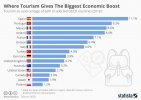
Looks at this chart of tourism as a percentage of GDP:

13829.jpeg

Look at the employment sector involved in tourism:

Number of enterprises in tourism industries.png

The contributions to Spain's economy from tourism is massive and is clearly a net positive to Spaniards.
 
Back
Top