Has Argentina Become Worse Or Better for Foreign Retirees recently?

1) I am not AI or a LLM. I simply use points to separate responses, I don't know how you quote just sections without quoting the whole post. The hierarchical response is help keep it ordered and clearly differentiate between points.
My AI detector (there are several out there) begs to differ, several of your posts got an 80% or more AI score before I called you out on it. I can provide examples, if you like. You have cleaned up your act, but the suspicion remains, and there are ways to make AI-generated text more human. They do seem to make the resulting output less coherent, though.

If you want to quote sections, click the "Toggle BB code" symbol ("[ ]") at the top of the response window. You will see the quoted post between something like this:

This is just an example, he didn't actually say this.

Every section you quote must be enclosed by the "Quote" blocks. It is more work, but it has the advantage that you can leave out parts of the post you're responding to that you consider irrelevant. Check the preview (top right) first, it's easy to forget square brackets or slashes.

2) My initial response to a post Lanick made
Reply to Lanick then, I won't see it, he's on my ignore list.

10) To clarify, although mentioned above, the "all the hate" wasn't about a response to my comment, it was about the seeming hate and non-recommendation of retiring or living in Argentina. Just because the cost has gone up it is still a great place. If cost is your most sensitive or overweight determining factor, then maybe Argentina is no longer "the winner". But it is hardly a bad place to live. And before criticizing Argentina about the cost of living for a pensioner from the US, it is worth asking the question about the state of SS in the US and why one can't retire in the US after a lifetime of work and contributions. Its an unfortunate state of the system and government abuse. Similar worldwide though, not special to just the US.
Again, nothing to do with me, I'm neither a pensioner, nor am I from the US. If you want to reply to someone else, then please do so.
 
regardless of whether you earn in pesos, or bring in euros, dollars, or rubles, everything is more expensive.
inflation has slowed, but its certainly not gone.
everybody has different incomes, sources of money, and opinions on what things "should" cost, but the prices still keep going up.

obviously, it hits the average argentine who earns the average salary, much harder than the more affluent, whether they are argentines or expats.

yes, the dollar has been pretty flat- which just means the pain is more evenly spread out.

I have always said- move to Argentina because you like it and want to live here, not because its cheap.
The cheap chasers are always moving around the world.
I am old enough to remember hearing stories about my dad's buddies living in Paris and going to school there on the GI bill, because it was so much cheaper than the US. (that was in the 50s)
I remember hippies sleeping on the beach in Mexico in the 60s,, or the post punk exodus to Berlin and Prague in the 80s, or the days when Ubud was so cheap you could live on two trips a year back to LA selling sarongs and carvings.
Someplace is always cheaper.
Most places are still more expensive than they used to be.
 
With all due respect, you're overthinking this. The image was simple, simplify it further by ignoring the USD / ARS conversion rate, or treating it a a reference, or baseline. You're still left with a 6x price increase in some basic consumer goods.


Apologies to the OP if I hijacked the thread, but threads do move on, and I'm responding to the latest arguments. I'm highlighting 6x Peso price increases. If you want to argue that "Peso purchasing power has not been affected to the extent that USD purchasing power has", then sure, I'll give you that, but do you think 6x Peso price increases are sustainable? I am fortunately not dependent on any sort of social security. Please don't project.

Mileinomics may have fixed a distortion, but has maintained, or introduced, others. Do we still have a "Cepo"? Of course. Is there a single, open-market exchange rate? No. Mileinomics will run only until it runs out of other people's money.

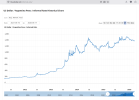
1) In 2023 the Blue Dollar never hit 1430. The highest it was 1220 and that was after election and then it dropped. So cherry picking data doesn't help your argument. See charts of currency below.
2) You continue to ignore and accept 2 things,
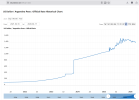
i) The meat previously was priced with the official exchange rate not the blue dollar rate. So again, the government was maintaining an artificially strong peso.
ii) I have presented the policies that restricted free trade of both Beef and Petrol. So both those examples highlight that there were in fact government policies restricting the fair pricing of those goods. So it is not surprising that these these were lower and more affordable and therefore consumed far more. It is no different than a government buying votes.
3) The result of points 1) and 2) indicate you are not debating in good faith.
4) Is there a cepo still? It partially exists, but the market is trading freely until it hits the bands. The bands were only touched around election time last year. Other than that, companies are allowed to repatriot dividends from last year and onwards. There are no limits to how much individuals can buy or sell. So for the most part it is effectively eliminated.
5) What is the Mileinomics that is consuming others money? They are building up reserves so they can have a robust financial system and move to an eventual fully free floated currency. Even with the government buying dollars, there has still been net downward pressure because provincial and federal government and domestic companies are raising debt in dollars and converting back to pesos to spend it. And to suggest a government buying dollars is interference, most countries hold substantial foreign currency reserves to not restrict exchange and support free floating currencies.

Blue Dollar Exchange Rate

1776445228013.png
Official Exchange Rate
1776445564580.png
My AI detector (there are several out there) begs to differ, several of your posts got an 80% or more AI score before I called you out on it. I can provide examples, if you like. You have cleaned up your act, but the suspicion remains, and there are ways to make AI-generated text more human. They do seem to make the resulting output less coherent, though.
I can assure you I am a person. This might be evidence that AI isn't always that good. There is a guy on Scoial Media with many videos of very simple things that ChatGPT fails in regularly.

Reply to Lanick then, I won't see it, he's on my ignore list.
My first post was to Lanick, and you you replied so I subsequently replied to you and you were asking why I mentioned what I did.

Again, nothing to do with me, I'm neither a pensioner, nor am I from the US. If you want to reply to someone else, then please do so.
There are more participants than just you, and some points involve complete thoughts around a topic.
 
If you want to quote sections, click the "Toggle BB code" symbol ("[ ]") at the top of the response window. You will see the quoted post between something like this:


Every section you quote must be enclosed by the "Quote" blocks. It is more work, but it has the advantage that you can leave out parts of the post you're responding to that you consider irrelevant. Check the preview (top right) first, it's easy to forget square brackets or slashes.
Thanks for these instructions. I learnt something new today.
 
@FrankPintor

There is a valid debate about "Mileinomics" being had at a grassroots level, that I wonder if expats really grasp. Expats hoping that Milei isn't elected so that the dollar is higher should carefully consider what it is that they are actually hoping for. What makes the dollar expensive is not spending on Public works or social welfare programs, it's fiscal deficits through public overspending and private investments hedging themselves into the dollar as a result. The dual effect of peso devaluation through inflation and private hoarding of dollars creates the "cheap Argentina" for expats. If Peronismo were for example to simply redirect military spending to state universities instead along purely idealogical lines without causing a fiscal deficit it wouldn't change the dollar at all for expats. What expats hope for (when speaking about the dollar) then isn't political at all really, it's actually hoping for fiscal imbalance.

I would further argue that the debate between Peronismo and Mileinomics then is not split along ideological lines so much as fiscal lines. I'm reminded of when Trump said the USPS should be privatized because it's "not a profitable business". Many Americans began to question whether the intent of Federal governed mail as a public service was actually a "business" or ought to have a profit at all. This is the very crux of the debate being had. It's not that Milei hates Jubilados, doctors and teachers. It's that he believes a fiscal deficit robs the wealth of the people through inflation and is a monetary sin. This Austrian economics at work, treating public finance the same as household finance. The schools of economics such as Modern Monetary Theory argue that unlike a household, Public deficits are sometimes necessary to avoid recessionary forces and "business cycles".

The real debate is this: Is Education/Healthcare/Retirement a cost, an investment, or a public service? What do you do when despite deficits, you still have recessionary forces. What happens when fiscal deficits are so large, that deficits itself causes recessionary forces.

Expats are caught between very fundamental questions of the role of government, the responsibility of the Treasury, the role of Central banks and avoiding the tragedy of the commons that a popular vote President inherently entails (as a opposed to a parliamentary Prime Minister for example).
 
Considering that the Milei government includes many lifelong peronists in positions of power, and that the definitions of peronism AND milieism are fluid and vary widely depending on the opinion holder, my opinions about milei have nothing to do with exchange rates, but, instead, how my Argentine friends are affected by cuts in government services, inflation, infrastructure decay, institutional collapse of essential government departments, job losses, less employment and educational availability, and so on.
The central bank, regardless of nominal political views of leadership, has been consistently unable to buck the global economy for 50 years.
Milei “ believes “ a lot of stuff.
Most of it is libertarian theory that has failed again and again globally.
 
The satisfaction level for most expats depends on the market value of the Blue dollar- The predicted value of the dollar, for year end 2026, is $1676 pesos.

Could someone mention the applications used to detect AI created texts, it has been mentioned that some presentations were supposedly created using ChatGpt
 
The satisfaction level for most expats depends on the market value of the Blue dollar- The predicted value of the dollar, for year end 2026, is $1676 pesos.

Could someone mention the applications used to detect AI created texts, it has been mentioned that some presentations were supposedly created using ChatGpt

Its understandable that foreigners opinion and preferences can be shaped by the Blue Dollar. It directly impacts the cost of living.

But the point being highlighted, is that you have an individual desiring both a more valuable Blue Dollar rate (ideally to return to the multiple value over the official as was the case years ago) and the implication that for that to occur, it would actual be disastrous for the economy and Argentinians. It would be a return to failed policies, no savings or growth potential for the population and a return to spiraling inflation. So while individuals are trying to promote in their opinions "pro" Argentina policies, they are actually hoping for the opposite to occur for the benefit of their wallet.

Individuals should be deciding for themselves at what point it becomes too expensive and come up with an alternative location and potentially begin making plans if they are approaching that limit, rather than hoping their host country fails.
 
History tends to repeat itself. Menem, for the Benefit of Argentinians kept the dollar flat for almost ten years. Many benefited with this Strong Peso 1:1 /(Peso/dollar) . The famous "Deme dos" story Eventually the government couldn't sustain that exchange rate, so one day the exchange ratio went to 3:1 a massive devaluation, everything exploded in mid air. It had been just an exchange mirage.

Expats together with millions of Argentine Exporters are hoping for a better dollar exchange rate to succeed (Exporters see their margins shrink daily, many go out of business. ).

Moving to a foreign country, is a business proposition, based on profit/loss expectations and local stability. Same as when businesses choose Bangladesh or Vietnam due to more advantageous economic conditions. the relative well being of the host country doesn't play a significant role in the equation. Business ethics is a subject left for Economists/historians.
 
Back
Top