
Claro prepaid plans unadvertised...

Well, I've been testing for six days. I purposely turned off wifi on my phone to test the 2GB theory. I also made two short test calls to my brother in the states, and I did an internet speed test with ookla's speed test and with Netflix' fast.com.

Cellular data:
  • The 2GB is really 2GB. (From using cellular for internet, I'm down to 1.3GB, not topped up each day. Sorry, Rob.) So keep your phone connected to wifi. If you really need a lot of internet via cellular, you'll have to buy packs or have some other solution.
Calling outside Argentina:
  • It appears based on the call details that calling the states is charged at the "America" rate, which is equal to the local call rate if you had to pay for local calls. $231 for the first 30 seconds, and 7.71 cents arg for each additional second. It works out to about US 30 cents/minute. The cost is about double that to call the rest of the world, except Cuba and "Destinos Satelitales" which are very high.
  • The cost of those calls outside of Argentina comes out of the 7000 that you "cargar/abonar"to get all the other perks like free 30 day Argentina calling and WhatApp.
  • I (and you) can cut the cost of those calls in half - 15 cents/minute - by paying the 7000 using Claro Pay and getting the 50% cash back.
  • The calls are clear - you dial them as a cellular call - I don't think there's any VOIP in the middle, but in any case, the calls are clear.
  • With my current postpaid Movistar plan, I pay for those calls in addition to the cost of the monthly plan, and at a rate somewhere about 45 cents/minute.
Internet speed:
  • Internet speed using cellular was about 45 mbits/s (ookla) and 49 mbits/s (fast.com). Of course, that's in CABA, in San Telmo, so that could vary, but that's faster than most people are likely to need - even Frank - and you'd blow through your 2GB pretty quick if you needed to be using up your cellular data at that speed.
I want to thank all the contributors to this thread.

It was an eye opener. In October, I paid Movistar 61,000 for my monthly plan, plus 20,000 for calls to the states. (My wife subsequently called and got them to cut the monthly charge in half, temporarily, but not the rate for the US calls.)

By following the instructions detailed in this thread, it should be possible to reduce my phone bill for an entire year to less than what I paid for that one month, without sacrificing any service that I was previously using.
 
Well, I've been testing for six days. I purposely turned off wifi on my phone to test the 2GB theory. I also made two short test calls to my brother in the states, and I did an internet speed test with ookla's speed test and with Netflix' fast.com.

Cellular data:
  • The 2GB is really 2GB. (From using cellular for internet, I'm down to 1.3GB, not topped up each day. Sorry, Rob.) So keep your phone connected to wifi. If you really need a lot of internet via cellular, you'll have to buy packs or have some other solution.
Calling outside Argentina:
  • It appears based on the call details that calling the states is charged at the "America" rate, which is equal to the local call rate if you had to pay for local calls. $231 for the first 30 seconds, and 7.71 cents arg for each additional second. It works out to about US 30 cents/minute. The cost is about double that to call the rest of the world, except Cuba and "Destinos Satelitales" which are very high.
  • The cost of those calls outside of Argentina comes out of the 7000 that you "cargar/abonar"to get all the other perks like free 30 day Argentina calling and WhatApp.
  • I (and you) can cut the cost of those calls in half - 15 cents/minute - by paying the 7000 using Claro Pay and getting the 50% cash back.
  • The calls are clear - you dial them as a cellular call - I don't think there's any VOIP in the middle, but in any case, the calls are clear.
  • With my current postpaid Movistar plan, I pay for those calls in addition to the cost of the monthly plan, and at a rate somewhere about 45 cents/minute.
Internet speed:
  • Internet speed using cellular was about 45 mbits/s (ookla) and 49 mbits/s (fast.com). Of course, that's in CABA, in San Telmo, so that could vary, but that's faster than most people are likely to need - even Frank - and you'd blow through your 2GB pretty quick if you needed to be using up your cellular data at that speed.
I want to thank all the contributors to this thread.

It was an eye opener. In October, I paid Movistar 61,000 for my monthly plan, plus 20,000 for calls to the states. (My wife subsequently called and got them to cut the monthly charge in half, temporarily, but not the rate for the US calls.)

By following the instructions detailed in this thread, it should be possible to reduce my phone bill for an entire year to less than what I paid for that one month, without sacrificing any service that I was previously using.
If you do need more data, there is the 40 gb for 60 days for about 32,000 pesos. But if you pay with Claro Pay, you get 50% back., so 16,000 for 2 months.
 
Internet speed:
  • Internet speed using cellular was about 45 mbits/s (ookla) and 49 mbits/s (fast.com). Of course, that's in CABA, in San Telmo, so that could vary, but that's faster than most people are likely to need - even Frank - and you'd blow through your 2GB pretty quick if you needed to be using up your cellular data at that speed.
I've been invoked 😬

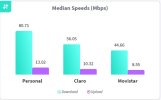
Certainly, 45Mbps will be enough for most things .Personal customers tend to demand more, possibly because the customer profile is different (more pre-paid, more business users). From Speedtest (Ookla):

median speeds.jpg


Data rates in Personal 5G are quite a lot higher, 500Mbps is not untypical. There are reasons for insisting on higher data rates, Argentina (both Claro and Personal) are finally deploying WTTH ("Wireless to the Home") with a wireless (cellular) connection for your modem. Home users expect 100+ Mbps download speeds.

The calls are clear - you dial them as a cellular call - I don't think there's any VOIP in the middle, but in any case, the calls are clear.

Just a minor point, maybe uninteresting for most, but cellular calls are almost all VOIP now. In 3G, the voice was packetized in the network, and in 4G and 5G, it's IP on the air interface as well, using VoLTE ("Voice over LTE") or VoNR ("Voice over New Radio"). Nothing "circuit switched" anymore, unless you have a very old mobile in which case you will be handed over to 2G or 3G, which can be quite painful.

Even though VoLTE is very nice technology, and can help in bad radio conditions, OTT ("Over the Top") applications like WhatsApp can give you better quality if you have good reception, because they were able to develop and roll out newer voice codecs. VoLTE codecs, on the other hand, need to be deployed to each mobile phone and embedded in the firmware.
 
There are reasons for insisting on higher data rates, Argentina (both Claro and Personal) are finally deploying WTTH ("Wireless to the Home") with a wireless (cellular) connection for your modem. Home users expect 100+ Mbps download speeds.

Just a minor point, maybe uninteresting for most, but cellular calls are almost all VOIP now. In 3G, the voice was packetized in the network, and in 4G and 5G, it's IP on the air interface as well, using VoLTE ("Voice over LTE") or VoNR ("Voice over New Radio"). Nothing "circuit switched" anymore, unless you have a very old mobile in which case you will be handed over to 2G or 3G, which can be quite painful.

Even though VoLTE is very nice technology, and can help in bad radio conditions, OTT ("Over the Top") applications like WhatsApp can give you better quality if you have good reception, because they were able to develop and roll out newer voice codecs. VoLTE codecs, on the other hand, need to be deployed to each mobile phone and embedded in the firmware.
I'm sure you've got very good reasons for needing those high speeds. But most people don't need them. They may want them - who wouldn't?, all other things being equal, but they don't need them. My very fast Movistar router barely ever uses more than 10% of its capacity, but it was only a couple dollars more a month than the lowest speed, so why not?

As far the calls to the states go, my real point, which I muddied up mentioning that I didn't know how they are carried, is that they are very clear, which with more testing continues to be the case. That's been pretty rare for me when calling the states over the last twenty years, so it's something people might consider.

Anyway, all minor points.
Cheers
 
Back
Top