
Los que más tienen

I have responded to points, and asked questions.
1) Students university is still free to citizens and perm residents.
2) Instructors and profs are getting paid. regardless whether I think its fair pay or not, they haven't exercised a right to strike or stop rendering services.

Austerity will have impacts. That is what the country voted for. You seem to want to override the will of the people.

You keep bringing up this book and her philosophy, I have already responded in 2 posts to it.
Continually repeating something, and on a superficial level doesn't make it true. You have not countered my point, which was really one of her points or at least a risk she raised.

You are not trying to debate in good faith.
You don't debate at all. You are like Milei himself, constantly deflecting, bringing up things that are not germane, spitting out tomes of words that make no sense and have nothing to do with and completely ignore the issue at hand. You address any and everything but the issue at hand. Your blame-shifiting and whataboutism are un-paralleled on this board.

The issue is withholding funding from public universities when the funding is a constitutional requirement. Milei is deliberately obstructing a constitutional requirement. I never said that public universities weren't free or no longer free to citizens or perm residents. And no, right now, professors are not getting paid. No hay plata.

Your wild-west free-market world sounds very scary. You sound like Peter Thiel - who cares, so what, the government has no business being involved in anything or providing anything to its citizens. Nations and liberal democracy are passé. Nations prevent multi-billionaires from extracting rare eath minerals, etc. They need to go. Are you a disciple of Peter Thiel by chance? Are you neighbors with him and Susana Giménez in Palermo?
 
I will say, that it seems capitalism writ large is sounding a lot more like what right wing leaders warned us socialism would be:"you'll own nothing and be happy." Under capitalism, spending power is being reserved for very few who go on to largely manipulate the markets and our lives. If the market was working, wages would rise to meet prices. But, capitalism desperately needs a permanent underclass to 'function.'

Before, those in power at least pretended that we all shared the same stakes, were privy to advancing. As you grow older you see that was a bit of a fib all along. No trickle down...just a slow ascent of my earnings on up toward the pockets of folks who've always had their hand firmly in the pot. Now, once-booming industries are also being consolidated under tech oligarchs...it doesn't shake out. The myth of working 'harder' and being a success is just that, a myth. How silly is it that from my hard labor, my boss gets wealthy and my earnings stay thin?

You have to have money to make money under these systems. "The Market," if it was true and real would be producing affordable housing, rich jobs with wages that met the moment. Instead, we're seeing all of the power/money tightly wound up and sorted between influential stewards of hypocrisy...in such an astounding way it's frightening. Monopolies, insider trading, corporate bail outs....to the same people who whinge about the welfare state.

Don't get me wrong, socialism has its own demons to contend with (mostly, folks who join the movement and siphon off funds meant to aid in our polite society and broader equality—there's grift everyplace). That leaves the ultra wealthy, to take money from other wealthy folks and just keep handing it around to the same accounts until there are actual trillionaires in existence and a growing number of people on the street. Like, sure...I like that I can more readily find a slice of pizza, but I'd also like to still be able to afford a Michelin star meal a few times a year, feel as though I won't have to work until I'm dead just to eek by. The rich gatekeeping life, and ensuring so few of us are allowed into the upper echelons, is a sickness that should be studied, surely.

As for austerity, why isn't it applied to those in government? And, when there is a surplus of cash...will that go back into the country (re: hospitals, education, public services for all) or be diverted to fund pet projects...like buying jet planes?
Very well said and argued!
 
I will say, that it seems capitalism writ large is sounding a lot more like what right wing leaders warned us socialism would be:"you'll own nothing and be happy." Under capitalism, spending power is being reserved for very few who go on to largely manipulate the markets and our lives. If the market was working, wages would rise to meet prices. But, capitalism desperately needs a permanent underclass to 'function.'

Before, those in power at least pretended that we all shared the same stakes, were privy to advancing. As you grow older you see that was a bit of a fib all along. No trickle down...just a slow ascent of my earnings on up toward the pockets of folks who've always had their hand firmly in the pot. Now, once-booming industries are also being consolidated under tech oligarchs...it doesn't shake out. The myth of working 'harder' and being a success is just that, a myth. How silly is it that from my hard labor, my boss gets wealthy and my earnings stay thin?

You have to have money to make money under these systems. "The Market," if it was true and real would be producing affordable housing, rich jobs with wages that met the moment. Instead, we're seeing all of the power/money tightly wound up and sorted between influential stewards of hypocrisy...in such an astounding way it's frightening. Monopolies, insider trading, corporate bail outs....to the same people who whinge about the welfare state.

Don't get me wrong, socialism has its own demons to contend with (mostly, folks who join the movement and siphon off funds meant to aid in our polite society and broader equality—there's grift everyplace). That leaves the ultra wealthy, to take money from other wealthy folks and just keep handing it around to the same accounts until there are actual trillionaires in existence and a growing number of people on the street. Like, sure...I like that I can more readily find a slice of pizza, but I'd also like to still be able to afford a Michelin star meal a few times a year, feel as though I won't have to work until I'm dead just to eek by. The rich gatekeeping life, and ensuring so few of us are allowed into the upper echelons, is a sickness that should be studied, surely.

As for austerity, why isn't it applied to those in government? And, when there is a surplus of cash...will that go back into the country (re: hospitals, education, public services for all) or be diverted to fund pet projects...like buying jet planes?

I said that it was a good example of the market filling the void. I am not a hard core right winger or free marketer across all industries, health care, especially, and I definitely support public education. I am absolutely not a trickle down economics or giving away major tax cuts. That being said, and I believe Ries pointed out, because of such a large percentage of informal work being performed in Argentina, taxes are heavily skewed to businesses.

Those with capital will always do better and improve. Wages would only be rising if there is more demand than supply of the desired labour. As it stands that is not the case in general. The reality is that if there are more people looking for jobs than available jobs, the wages will go down, and until an acceptable floor forms by those supplying labour (unemployed looking for work). There is a minimum wage, but unless it is enforced, it doesn't really matter. And given the state of informal labour and businesses here that is the case in general.

The affordability of Michelin is that its typically not. Its an unfortunate reality. Due to the deocration, level of service, quality of good, ingredients, and effort and time for each dishes preparation and plate setting it will always be expensive. That being said, a friend mentioned a Michelin Star rated restaurant/might also be a hotel or something, in Mendoza that was more affordable. Again, its pretty normal for per person costs to average $175-350+ depending on the number of stars and that excludes the drinks, which can easily be $100+ depending on what wines etc. There are of course the noodle place in Singapore or Hong Kong and tacos in Mexico City, but those are more the exception than the rule.

I agree that austerity should apply to those in government unfortunately they are the ones that have the ability to pass laws for themselves which includes their salaries. Milei himself has not taken a raise as I understand but still I don't think that matters since his housing, food, cost of living is paid for by the state. I think the surplus is not a huge amount, and is essentially covering costs, and then used for next years budget. Since there isn't a deficit spending budget, that money is effectively being reinvested or spent in the country. The alternative would be larger loans to cover debt repayments. As an example, just yesterday I think, the speak of the house in the US was trying to defend congress people trading stocks because of their wages and how the economy is going, which is not right. They have access to information that is not public, and its too obvious that many have benefited off it.

I do like the idea originally, I think, proposed by Warren Buffet that politicians shouldn't be eligible for reelection if the deficit is greater than X% (might have been 2 or 3%).
 
You don't debate at all. You are like Milei himself, constantly deflecting, bringing up things that are not germane, spitting out tomes of words that make no sense and have nothing to do with and completely ignore the issue at hand. You address any and everything but the issue at hand. Your blame-shifiting and whataboutism are un-paralleled on this board.

The issue is withholding funding from public universities when the funding is a constitutional requirement. Milei is deliberately obstructing a constitutional requirement. I never said that public universities weren't free or no longer free to citizens or perm residents. And no, right now, professors are not getting paid. No hay plata.

Your wild-west free-market world sounds very scary. You sound like Peter Thiel - who cares, so what, the government has no business being involved in anything or providing anything to its citizens. Nations and liberal democracy are passé. Nations prevent multi-billionaires from extracting rare eath minerals, etc. They need to go. Are you a disciple of Peter Thiel by chance? Are you neighbors with him and Susana Giménez in Palermo?
I have absolutely addressed your point and questinoed it and your highlighted your favourite author's point. Claiming I have not is bad faith.

1) Universities are still free for permanent residents and students.
2) Universities are still open and functioning and educating students, so I don't know what you are claiming is unconstitutional or stopped.
3) Teaching staff and professors are not getting pay rises. but they are still delivering services.

Now about your author again, in your original post from the other thread
Key Aspects of Kelton’s Work:

  • "The Deficit Myth": Kelton is the author of this 2020 bestseller, which challenges conventional views on federal budgeting.
  • Modern Monetary Theory (MMT): Kelton argues that for a government that prints its own money (like the U.S.), a deficit is not a sign of financial weakness but rather a reflection of the private sector's surplus.
  • Focus on Resources, Not Money: Kelton argues the constraints on spending are not tax revenue but available resources (labor, materials) and inflationary pressures, rather than a fixed budget.
  • Policy Positions: She argues that deficits can be used to invest in infrastructure, education, and research to drive long-term productivity and growth.
I have repeatedly defended using deficit budgets.
I have also stated:
1) Milei was elected on a campaign promising to balance the budget and not have a deficit spending
2) The above quote from you highlight that Kelton understands inflationary pressures play a role in the ability to deficit spend. This is a combination of monetary and fiscal policy. If you can just print money and spend infinitely then why work? why tax? why not provide everything for free?

Do you understand that the issue is printing will cause inflationary pressure? That is why they are not doing it. IF there aren't people demanding pesos, then the value will just go down, and you have a cycle of hyperinflation.

Running deficit budgets needs discipline and limits to how much. Again, as previously stated, running deficits where the deficit or percent increase in debt, is less than the increase in GDP as a percent, is acceptable. If you spend more then you have inflationary pressures. This is going on in the US right now. Trump doesn't care about deficit and he wants lower interest rates to reduce borrowing costs, meanwhile the fed doesn't want to lower rates because it will fan the flames of inflation while its already going on and increasing due to the war, tariffs, and other policies. This is why bond markets are what end up killing politicians (See the UK a couple years ago even), and political policies (Trumps liberation day announcement had to be modified and reduced the next day I think it was because of the spike in bond rates).

I have also presented the impact on Argentinian bonds to present to you the risk is real in terms of financing if there is a return to previous policies. The opposition has not provided any real platform on how they plan to fund everything.

It really sucks that resources and money are scarce and everyone can't get everything they want when they want it. But that is the reality. Governments are voted in by people based on their priorities.
 
Et voilà


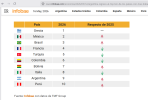
Lets have a look at the complete list, snip below.
Pretty amazing that its full of South American and some European countries.

When we look at the article, it is pointing at benefits by the administration and what they have done, some streamlining and digitizing, lowering of country risk to make financing easier, labour reforms.
Some things again, are provincial in nature, including all the manual forms etc required.
In CABA you can make a business, SAS, online and receive a CUIT in 24 hours.
On other provinces it is a 2 month process with numerous stages, forms, escribanias at least twice, accountants and lawyers required. This is not due to the national government but rather provincial.

So we say business will go to Brasil, but its number 3 on the list, Bolivia 7. Mexico where there is tons of offshoring of American and Canadian manufacturing, especially due to USMCA is #2. Then you still have Greece (1), France (4), Turkey (5) and Italy (8). Turkey is also major outsourcing hub for the rest of Europe due to lower costs. Some of the complaints for people trying to apply for residencies in Europe is related to many of these same factors related to bureaucracy. Something, to the best of my knowledge this administration has tried to reduce.

1778958419935.png
 
Lets have a look at the complete list, snip below.
Pretty amazing that its full of South American and some European countries.

When we look at the article, it is pointing at benefits by the administration and what they have done, some streamlining and digitizing, lowering of country risk to make financing easier, labour reforms.
Some things again, are provincial in nature, including all the manual forms etc required.
In CABA you can make a business, SAS, online and receive a CUIT in 24 hours.
On other provinces it is a 2 month process with numerous stages, forms, escribanias at least twice, accountants and lawyers required. This is not due to the national government but rather provincial.

So we say business will go to Brasil, but its number 3 on the list, Bolivia 7. Mexico where there is tons of offshoring of American and Canadian manufacturing, especially due to USMCA is #2. Then you still have Greece (1), France (4), Turkey (5) and Italy (8). Turkey is also major outsourcing hub for the rest of Europe due to lower costs. Some of the complaints for people trying to apply for residencies in Europe is related to many of these same factors related to bureaucracy. Something, to the best of my knowledge this administration has tried to reduce.

View attachment 10935
Also, remember the months of riots and massive damage caused during the protests in France when they had to increase age of retirement in 2023 from 62 to 64?
Their debt is 110% of GDP, their deficit is around 5% which is higher than the 3% limit by the EU. They are straining to keep it together. Many feel France is next for major economic failure. They are also one of the largest industrial bases in EU.
Feel free to look into their economy and government policies and see whats happening.

They have gone through 3 prime ministers since 2024 as a result, the last one stepped down and was then reappointed. He had to make some concessions, but he also invoked constitutional powers to enact policy and bypass no confidence votes.

Its easy to criticise politicians, and be an armchair warrior. It is a lot harder to actually run a country than many want to realize.
 
I said that it was a good example of the market filling the void. I am not a hard core right winger or free marketer across all industries, health care, especially, and I definitely support public education. I am absolutely not a trickle down economics or giving away major tax cuts. That being said, and I believe Ries pointed out, because of such a large percentage of informal work being performed in Argentina, taxes are heavily skewed to businesses.

Those with capital will always do better and improve. Wages would only be rising if there is more demand than supply of the desired labour. As it stands that is not the case in general. The reality is that if there are more people looking for jobs than available jobs, the wages will go down, and until an acceptable floor forms by those supplying labour (unemployed looking for work). There is a minimum wage, but unless it is enforced, it doesn't really matter. And given the state of informal labour and businesses here that is the case in general.

The affordability of Michelin is that its typically not. Its an unfortunate reality. Due to the deocration, level of service, quality of good, ingredients, and effort and time for each dishes preparation and plate setting it will always be expensive. That being said, a friend mentioned a Michelin Star rated restaurant/might also be a hotel or something, in Mendoza that was more affordable. Again, its pretty normal for per person costs to average $175-350+ depending on the number of stars and that excludes the drinks, which can easily be $100+ depending on what wines etc. There are of course the noodle place in Singapore or Hong Kong and tacos in Mexico City, but those are more the exception than the rule.

I agree that austerity should apply to those in government unfortunately they are the ones that have the ability to pass laws for themselves which includes their salaries. Milei himself has not taken a raise as I understand but still I don't think that matters since his housing, food, cost of living is paid for by the state. I think the surplus is not a huge amount, and is essentially covering costs, and then used for next years budget. Since there isn't a deficit spending budget, that money is effectively being reinvested or spent in the country. The alternative would be larger loans to cover debt repayments. As an example, just yesterday I think, the speak of the house in the US was trying to defend congress people trading stocks because of their wages and how the economy is going, which is not right. They have access to information that is not public, and its too obvious that many have benefited off it.

I do like the idea originally, I think, proposed by Warren Buffet that politicians shouldn't be eligible for reelection if the deficit is greater than X% (might have been 2 or 3%).
I've worked at Michelin star joints in Chicago as a sommelier. A middle class family used to be able to dine at most of them. Here in Buenos Aires as well. I used to dine at them frequently on a lower middle class wage. Now, those wages have me pegged at near poverty level when compared to purchasing power. People are seeing wages that used to afford them vacations, dining out regularly, having disposable income...are now unable to even afford their mortgage/rent and the basics. This is why the system is failing. It's obvious. Any scraps that the governments can hoard, Joe citizen will never see it. Wages are low to bulk accounts of a very slim upper class these days. Essentially, I'm told to stop living so that a few folks at the top can do it, instead. However, my labor...they'll keep siphoning off its value. Politicians shouldn't be able to accept bribes by way of 'campaign donations' and should never, ever be able to trade on the market with the privileged positions they hold. It's all the biggest scam I've seen. In one breath Trump can sink the markets, then bolster them the next day. It's not reality. It's a system made and held together by corruption. And most folks suffer it, and will sadly suffer more if we accept this as the norm.
 
I have absolutely addressed your point and questinoed it and your highlighted your favourite author's point. Claiming I have not is bad faith.

1) Universities are still free for permanent residents and students.
2) Universities are still open and functioning and educating students, so I don't know what you are claiming is unconstitutional or stopped.
3) Teaching staff and professors are not getting pay rises. but they are still delivering services.

Now about your author again, in your original post from the other thread
Key Aspects of Kelton’s Work:

  • "The Deficit Myth": Kelton is the author of this 2020 bestseller, which challenges conventional views on federal budgeting.
  • Modern Monetary Theory (MMT): Kelton argues that for a government that prints its own money (like the U.S.), a deficit is not a sign of financial weakness but rather a reflection of the private sector's surplus.
  • Focus on Resources, Not Money: Kelton argues the constraints on spending are not tax revenue but available resources (labor, materials) and inflationary pressures, rather than a fixed budget.
  • Policy Positions: She argues that deficits can be used to invest in infrastructure, education, and research to drive long-term productivity and growth.
I have repeatedly defended using deficit budgets.
I have also stated:
1) Milei was elected on a campaign promising to balance the budget and not have a deficit spending
2) The above quote from you highlight that Kelton understands inflationary pressures play a role in the ability to deficit spend. This is a combination of monetary and fiscal policy. If you can just print money and spend infinitely then why work? why tax? why not provide everything for free?

Do you understand that the issue is printing will cause inflationary pressure? That is why they are not doing it. IF there aren't people demanding pesos, then the value will just go down, and you have a cycle of hyperinflation.

Running deficit budgets needs discipline and limits to how much. Again, as previously stated, running deficits where the deficit or percent increase in debt, is less than the increase in GDP as a percent, is acceptable. If you spend more then you have inflationary pressures. This is going on in the US right now. Trump doesn't care about deficit and he wants lower interest rates to reduce borrowing costs, meanwhile the fed doesn't want to lower rates because it will fan the flames of inflation while its already going on and increasing due to the war, tariffs, and other policies. This is why bond markets are what end up killing politicians (See the UK a couple years ago even), and political policies (Trumps liberation day announcement had to be modified and reduced the next day I think it was because of the spike in bond rates).

I have also presented the impact on Argentinian bonds to present to you the risk is real in terms of financing if there is a return to previous policies. The opposition has not provided any real platform on how they plan to fund everything.

It really sucks that resources and money are scarce and everyone can't get everything they want when they want it. But that is the reality. Governments are voted in by people based on their priorities.
I was talking about Naomi Klein, not Stephanie Kelton. They are two different women. Yes, in one post, I mentioned Stephanie Kelton and her economic theories. In at least two other posts, I referred to Naomi Klein and her book The Shock Doctrine.
 
Lets have a look at the complete list, snip below.
Pretty amazing that its full of South American and some European countries.

When we look at the article, it is pointing at benefits by the administration and what they have done, some streamlining and digitizing, lowering of country risk to make financing easier, labour reforms.
Some things again, are provincial in nature, including all the manual forms etc required.
In CABA you can make a business, SAS, online and receive a CUIT in 24 hours.
On other provinces it is a 2 month process with numerous stages, forms, escribanias at least twice, accountants and lawyers required. This is not due to the national government but rather provincial.

So we say business will go to Brasil, but its number 3 on the list, Bolivia 7. Mexico where there is tons of offshoring of American and Canadian manufacturing, especially due to USMCA is #2. Then you still have Greece (1), France (4), Turkey (5) and Italy (8). Turkey is also major outsourcing hub for the rest of Europe due to lower costs. Some of the complaints for people trying to apply for residencies in Europe is related to many of these same factors related to bureaucracy. Something, to the best of my knowledge this administration has tried to reduce.

View attachment 10935
From the article in the Buenos Aires Herald:

“The business environment remains demanding, marked by unpredictable regulatory changes and an administrative burden that is expected to grow over the next year,” the report said.

And

"Marcelo Abad, director of the Investment Diploma program at Universidad Austral, told the Herald that in 2026 “there is a marked improvement in macroeconomic expectations and in pro-market sentiment compared with previous years.”

He pointed to “the slowdown in inflation and the drop in country risk, which make it easier for capital to come in and for projects to be planned.”

Even so, he acknowledged that “significant weak spots remain, tied to the level of activity, financing and medium-term regulatory uncertainty.”
Abad also said the lack of investment in ports, railways and highways — a consequence of the halt in public-works spending — could create “a major bottleneck” for the expansion driven by the country’s natural resources.

Why introduce the infobae info? To sidetrack, to deflect, the play the whataboutism game. That's why.

And by the way, the Buenos Aires Herald article says NOTHING about Argentina digitizing and or even trying to develop a solid digital infrastructure, which you claim they say. The article in the Buenos Aires Herald specifically says "...an administrative burden that is expected to grow over the next year."
 
Also, remember the months of riots and massive damage caused during the protests in France when they had to increase age of retirement in 2023 from 62 to 64?
Their debt is 110% of GDP, their deficit is around 5% which is higher than the 3% limit by the EU. They are straining to keep it together. Many feel France is next for major economic failure. They are also one of the largest industrial bases in EU.
Feel free to look into their economy and government policies and see whats happening.

They have gone through 3 prime ministers since 2024 as a result, the last one stepped down and was then reappointed. He had to make some concessions, but he also invoked constitutional powers to enact policy and bypass no confidence votes.

Its easy to criticise politicians, and be an armchair warrior. It is a lot harder to actually run a country than many want to realize.
You must be really yearning for a Rassemblement National government in France.
 
Back
Top